2026 ACA Subsidies: What’s Happening With Advance Premium Tax Credits?        

(What Consumers Need to Know for the 2026 Marketplace)

D. Kenton Henry – editor, agent, broker

As we approach the 2026 plan year, one of the biggest questions in individual and family health insurance is what will happen to Advance Premium Tax Credits (APTCs)—the subsidies that lower monthly premiums for millions of Marketplace enrollees.

Why This Is Happening

During the COVID era, Congress passed temporary legislation — most recently extended under the Inflation Reduction Act (IRA) — which made Marketplace subsidies more generous and available to more households. These enhanced subsidies are scheduled to expire at the end of 2025, unless Congress acts to extend them.

If they expire, the Marketplace will revert to pre-COVID subsidy rules, which means:

1. Lower income thresholds for subsidy eligibility

Some households who qualified for subsidies under the temporary rules will no longer qualify at all.

2. Smaller subsidies for many who remain eligible

People who received very large subsidies during 2021–2025 would see higher net premiums for 2026, even if their income has not changed.

3. The return of the “subsidy cliff”

Under pre-COVID rules, households with income even slightly above 400% of the Federal Poverty Level received no subsidy. The COVID-era rules removed that cliff. If not renewed, the cliff returns.

This is why some people are seeing early projections showing their 2026 premiums rising sharply.


Where Things Stand in Congress

Both parties publicly acknowledge that the expiration would lead to large premium increases for many families. As of today:

  • There is broad interest in finding a solution, but
  • No final legislation has been passed,
  • No guarantee exists that the enhanced subsidies will continue, and
  • Any resolution will likely be tied to larger budget negotiations.

In short: Congress is still debating it, and the outcome directly affects what consumers will pay for Marketplace coverage in 2026.


What Consumers Should Expect

Until Congress acts, the Marketplace must begin preparing 2026 rates under the assumption that the enhanced subsidies expire. This means:

  • Preliminary quotes may show dramatically higher net premiums
  • Some currently subsidized families may temporarily appear ineligible for assistance
  • Final 2026 subsidy amounts cannot be known until legislation is passed — if it is passed

It is important to remember that this may change, depending on Congressional action in the coming months.


Practical Guidance for Individuals and Families

  • Don’t panic if early projections show large increases.
  • Stay informed — subsidy rules may be extended or modified.
  • Review your 2026 options with a licensed, experienced broker who can calculate subsidies under both scenarios.
  • Update income estimates accurately during Open Enrollment; small changes can affect substantial tax credit differences.

Bottom Line

The enhanced ACA subsidies that helped make Marketplace coverage more affordable since 2021 are set to expire after 2025, and Congress has not yet determined whether they will be renewed. Until a resolution is reached, 2026 Marketplace premiums may appear significantly higher for many Americans.

I will continue to monitor developments closely and provide updates as soon as new information becomes available.

Additionally—

It has come to my attention that my clients have been told the First Health PPO network plan is being mistakenly interpreted by them as being an Affordable Care Act (ACA) compliant PPO network. As such, they incorrectly believe any and all of their pre-existing health conditions will be covered and that all preventive exams and medicine will be covered at no out-of-pocket cost to them. This is wrong and here is the truth, as confirmed by me and ChatGPT:

1. There are no ACA-compliant PPO plans available in Texas individual/family (On- or Off-Exchange)

Texas has not had a true ACA-compliant individual market PPO option for several years.
All carriers (BCBSTX, Ambetter, United/Optum, Aetna CVS, Oscar, Cigna, Moda, etc.) offer only:

  • EPOs
  • HMOs

These networks limit out-of-network benefits and require referrals or tighter network management.

A PPO requires:

  • National or multi-state contracted provider access
  • True out-of-network benefits
  • No referral requirement

No carrier has offered this in the ACA individual Texas market since around 2017–2018.


2. Aetna is not selling ACA individual/family plans in Texas for 2026 (and has already exited)

Your clients may be confused because Aetna offers:

  • Medicare Advantage PPOs
  • Employer-based PPOs
  • First Health networks tied to group/other products

But Aetna does NOT offer ACA individual/family plans in Texas for 2026.

So if someone believes they have an “Aetna PPO” under an ACA plan, they are mistaken. It is either not an ACA plan, or they are misinterpreting the network type.


3. If their plan is marketed as “PPO-like,” it is almost certainly:

a) A short-term medical plan

These frequently use PPO networks—including Aetna’s First Health—but they are:

  • NOT ACA-compliant
  • Do NOT cover pre-existing conditions
  • Can cap benefits
  • Can deny claims based on underwriting

b) A health-sharing ministry

Often marketed as “PPO plans” because they use rented networks, but also:

  • Not insurance
  • Not regulated as insurance
  • No claim guarantees
  • No ACA protections

c) A fixed-benefit plan that uses First Health or MultiPlan PPO

Again:

  • Not insurance
  • No ACA protections
  • No out-of-pocket maximums
  • No guaranteed coverage

d) A direct primary care + medical indemnity bundle

These are sometimes misrepresented as “PPO plans,” but they are not.


4. How to confirm instantly whether the client is on ACA-compliant coverage

Ask for one of the following:

A) The name of the carrier.

If it’s not:

  • BCBSTX
  • Cigna
  • Ambetter
  • UnitedHealthcare (UHC Marketplace)
  • Aetna CVS (in some states, but NOT Texas 2026)
  • Moda
  • Oscar (until exit)

…then it’s almost certainly not ACA-compliant.

B) A copy of the Summary of Benefits & Coverage (SBC).

All ACA plans must include an SBC — short-term plans and sharing ministries do not.

C) Their monthly bill or ID card.

If it says things like:

  • First Health Network
  • MultiPlan PPO
  • PHCS PPO
  • Aetna PPO
  • United Healthcare Choice/Choice Plus PPO

…that is almost certainly a non-ACA plan.


5. Bottom line for you:

If you believe you they are on an ACA-compliant “Aetna PPO” for individual/family coverage:

You are not. No such product exists in the Texas ACA market. You are almost certainly on a short-term plan, health-sharing product, or fixed-benefit plan using a rented PPO network.

This is an excellent opportunity for ne to help you transition to true ACA coverage, where you will regain:

  • Pre-existing condition protection
  • Essential health benefits
  • No annual/lifetime caps

And – perhaps most importantly – Out-of-pocket maximum protection

Please feel free to call me with any questions you may have or for assistance in obtaining 2026 ACA compliant health insurance. I will make the quoting and application process go as quickly and smoothly as possible whether you quailify for a subsidy or not.

The Open Enrollment Period for a January 1 effective date ends December 15th. You have until January 15th to obtain an effective date of February 1.

D. Kenton Henry
Office: 281-367-6565
Text my cell 24/7@ 713-907-7984
Email: Allplanhealthinsurance.com@gmail.com

Leave a comment

https://TheWoodlandsTXHealthInsurance.com
https://Allplanhealthinsurance.com
https://HealthandMedicareInsurance.com

What Texas Consumers Must Know as the 2026 Individual & Family Health Insurance Market Evolves


By D. Kenton Henry, Editor / Agent / Broker — TheWoodlandsTXHealthInsurance.com, AllPlanHealthInsurance.com, HealthandMedicareInsurance.com 30 October 2025

Each November in Texas marks more than just the start of the new health insurance year—it’s your gateway to securing coverage for the year ahead. This time around, the 2026 individual and family health insurance market is undergoing noticeable changes. Here’s what you need to know—and how you can be ready.


1. Why 2026 matters

Open enrollment for 2026 policies begins November 1, 2025, and runs until January 15, 2026 for most Texas consumers. If you don’t act in this window, you could be locked out of making changes until next year unless a qualifying life event occurs. Given major shifts among carriers and plan options, early action is more important than ever.


2. Carrier changes you should track

One of the major headlines: Aetna will exit the Texas individual and family market beginning in 2026. That means if you currently have an Aetna plan, your policy will not renew for 2026. You’ll need to select a different carrier in the upcoming enrollment period.

Other carriers are repositioning their offerings, adjusting networks, benefits, and rates. Even if your carrier is staying, plan names and design may change. As your broker, I’ll review all available options from multiple carriers and ensure you’re not simply renewing by default.


3. What this means for you

  • No automatic renewal: If your carrier exits the market, your current plan will not carry over. You’ll receive a Notice of Change—or termination—and need to select a new plan.
  • Shop your options: Differences between plans are not only about monthly premiums. Review networks, cost-sharing, deductibles, out-of-pocket maximums, and whether benefits match your healthcare needs.
  • Subsidy changes: The federal subsidy rules continue to evolve. Even small changes in income, household, or eligibility can shift your subsidy level. I’ll help you analyse eligibility for Advance Premium Tax Credits (APTC) and other cost-saving tools.
  • Timing matters: Beginning November 1, I’ll be available to assist you through the selection process—not just on carriers and plans, but on ensuring accurate enrollment to avoid coverage gaps.

4. Why working with a broker matters

As an independent broker specializing in medical insurance since 1986, I work with virtually every major carrier licensed in Texas. My services to you are free of charge. My goal is to ensure you get the best plan that fits your health needs, budget, and preferences—especially in a year of significant market change.
Rather than navigating dozens of plan names on your own, let me do the heavy lifting and help you make an informed choice.


5. What to do now

  1. Gather your information – your current health plan, recent premium receipts, summary of benefits, and any health changes.
  2. Schedule your review – open enrollment kicks off November 1. If you’d like early preparation, I’m available now to pre-review your situation so you’re ready to act.
  3. Act during the window – November 1 through January 15 is your open period. Plans go into effect January 1, 2026, or, depending on carrier rules, as early as December 1, 2025.
  4. Don’t wait – with carrier exits and plan redesigns in motion, the sooner you start the review, the better your chance of finding the optimal match.

Working together, we’ll turn these market shifts into an advantage—so instead of scrambling when notices arrive, you’ll move confidently into 2026 with coverage aligned to your needs. Let me handle the complexity so you can focus on your life, your health, and your goals.

If it’s after hours, or you simply prefer, you can do preliminary research before calling me by obtaining quotes from my quoting engine. You do NOT have to log in to obtain them but be certain to call me afterwards with questions, and assistance in finding your providers within the networks, as well as applying. CLICK HERE: https://allplaninsurance.insxcloud.com/get-a-quote

D. Kenton Henry

Editor · Agent · Broker
TheWoodlandsTXHealthInsurance.com * AllPlanHealthInsurance.com * HealthandMedicareInsurance.com

https://TheWoodlandsTXHealthInsurance.com
https://Allplanhealthinsurance.com
https://HealthandMedicareInsurance.com

NAVIGATING THE FRUSTRATIONS OF FINDING INDIVIDUAL AND FAMILY HEALTH INSURANCE

By D. Kenton Henry
Editor, Agent, Broker

Finding Your Doctor and Understanding Subsidies in HMO Plans

Shopping for individual or family health insurance can feel like navigating a maze—with dead ends, confusing signs, and few clear answers. Two of the most common pain points for shoppers are (1) trying to keep your current doctor while limited to an HMO network and (2) figuring out whether you qualify for a subsidy, known as an advance premium tax credit (APTC). Both challenges can make the process frustrating and overwhelming, especially during open enrollment when time is limited.

One of the biggest shocks people face when shopping for health insurance is realizing that their trusted doctor or medical provider might not be covered under a new plan—especially if it’s an HMO (Health Maintenance Organization). Unlike PPOs (Preferred Provider Organizations), which offer broader provider access and out-of-network options, HMO plans restrict coverage to a specific network of doctors and hospitals. If your doctor isn’t in the network, you may have to pay the full cost of your visit out of pocket—or switch doctors entirely.

  • Outdated or Inaccurate Provider Directories: Online directories can be incomplete or outdated. It’s not uncommon for a provider to be listed as “in-network” only for you to find out later they’ve left the plan.
  • Hard-to-Navigate Insurance Websites: Many insurance carrier sites don’t make it easy to search by doctor name, location, or specialty. Even worse, each plan may have its own “network tier,” adding another layer of complexity.
  • No Universal Search: There’s no centralized tool that lets you enter your doctor’s name and see every marketplace plan that includes them. You have to check each insurance company or plan individually.

For people with ongoing care needs—like managing chronic conditions or continuing with a trusted pediatrician or specialist—the possibility of switching providers isn’t just inconvenient, it can feel risky.

The Affordable Care Act (ACA) made health insurance more accessible by offering subsidies for people who meet certain income guidelines. These subsidies, officially called advance premium tax credits, lower your monthly premium based on your household size and income.

The good news is that many people qualify.

The bad news is that determining whether you qualify can feel like filling out a tax return just to get a quote.

  • Income Guesswork: Subsidy eligibility is based on your estimated household income for the upcoming year. That’s right—you must predict your future income, even if you’re self-employed or work variable hours.
  • Family Dynamics Matter: Your household size includes dependents—even if they don’t need insurance—and income from every working member. This means getting it right often requires gathering data from multiple people.
  • Mid-Year Changes Complicate Things: If your income or family size changes mid-year, you may need to report it or risk having to repay part of your subsidy at tax time.
  • The ACA “Cliff” and “Glide Path”: Previously, you could lose your subsidy entirely if your income was even $1 over the limit. Recent changes have smoothed this out, but they are still complicated and frequently misunderstood.

And while tools like Healthcare.gov’s calculator are helpful, they often rely on broad estimates. They can’t account for all variables, such as gig work, investment income, or multiple part-time jobs.

When you shop for health insurance, you’re not just picking a product—you’re making decisions that affect your finances, your family’s well-being, and your access to care. The stakes are high, yet the process often feels opaque and unnecessarily complicated.

  • Compare dozens of plans with unfamiliar terms,
  • Check if your providers are covered (without reliable tools),
  • Predict your income a year in advance,
  • And hope you don’t make a mistake that costs you money or coverage.

While the system isn’t perfect, there are ways to reduce frustration:

  • Use a Licensed Agent or Broker: Agents specializing in ACA plans can often help you find plans that include your provider and determine if you qualify for subsidies—all at no extra cost.
  • Call Your Doctor’s Office: Don’t rely solely on insurance directories. Call your provider’s office directly to confirm if they accept a specific plan.
  • Keep Documentation: If your income fluctuates, keep clear records. This will help you provide accurate estimates and support your case in the event of an audit or dispute.
  • Update Changes Promptly: If your income or household size changes mid-year, report it on your health insurance marketplace to avoid surprise bills or tax penalties.

Shopping for individual or family health insurance can be a stressful process—especially when you’re trying to keep your doctor and figure out if you qualify for financial help. Between restrictive HMO networks and confusing subsidy rules, it’s easy to feel stuck. But with a little extra diligence, some expert help, and the right questions, you can find a plan that fits your needs without sacrificing peace of mind.

If the process still feels overwhelming, you’re not alone. Many Americans share the same frustrations—and continue to hope for a more user-friendly system in the future.

Below is a chart outlining estimated income thresholds for qualifying for an Advance Premium Tax Credit (APTC) in 2025. These thresholds are based on a percentage of the Federal Poverty Level (FPL), which is adjusted annually. For simplicity, the chart includes 2024 FPL figures (used for 2025 coverage) and the income ranges (100%–400%+ of FPL) where most people qualify for subsidies under the ACA.

📝 Note: Due to the American Rescue Plan and Inflation Reduction Act, subsidies may extend beyond 400% of the FPL, with a sliding scale that caps the percentage of income spent on premiums. These extended subsidies are currently in place through 2025.

Household Size100% / FPL400% / FPLTypical APTC Eligibility Range

1 (Individual) $14,580 / $58,320 / $14,580 – ~$58,000+

2 (Couple) $19,720 / $78,880 / $19,720 – ~$79,000+

3 $24,860 / $99,440 / $24,860 – ~$99,000+

4 (Family) $30,000 / $120,000 / $30,000 – ~$120,000+

5 $35,140 / $140,560 / $35,140 – ~$141,000+

6 $40,280 / $161,120 / $40,280 – ~$161,000+

  • Minimum Income: You must earn at least 100% of the FPL to qualify for a subsidy in most states. In Medicaid expansion states, if you earn less than 138% FPL, you may qualify for Medicaid instead.
  • Upper Limit Removed: Thanks to temporary reforms, people earning above 400% FPL may still qualify for a subsidy if the cost of the benchmark plan exceeds ~8.5% of their income.
  • Household Size: Includes you, your spouse, and any dependents claimed on your tax return.
  • If your estimated annual income falls between the ranges shown above, you likely qualify for help paying your monthly health insurance premium.
  • Households earning more than 400% of the FPL may still qualify if their premiums exceed about 8.5% of income, thanks to current federal subsidy expansions.
  • Eligibility is based on your tax household — including you, your spouse, and dependents you claim on your tax return.
  • If your income is below 138% FPL, you may qualify for Medicaid (in most states).

DO NOT CALL AN 800 NUMBER and talk to some anonymous employee of an insurance company. Not only are they restricted to limiting you exclusively to their company’s options—but your personal information will be instantly sold and shared. Your phone is going to begin ringing off the hook!

I’ve been specializing in Medicare-related insurance for over thirty years, right here in The Woodlands, Texas, USA! I represent every Medicare-related product, including Supplement, Advantage, and Part D Drug plans, from virtually every “A” rated company doing Medicare-related business in Texas. And I CHARGE NO FEE for my services! Deal with a local agent/broker who values your business enough not to share it with anyone!

D. Kenton Henry
Editor, Agent, Broker
Office: 281.367.6565
Text my cell 24/7 @713.907.7984
Email: Allplanhealthinsurance.com@gmail.com

Leave a comment

https://www.woodlandsonline.com/blps/article.cfm?page=14062
Https://TheWoodlandsTXHealthInsurance.com
Https://Allplanhealthinsurance.com
https://healthandmedicareinsurance.com/2025/03/20/congratulations-youre-turning-age-65-and-eligible-for-medicare-whats-next/?fbclid=IwY2xjawJKSbBleHRuA2FlbQIxMQABHQbe0u7yebhaHWAa_6axQnzaMdTi9mM6TUvKICB6PZT-xV45uXovIMtEog_aem_0lPN3F7TsqV6X7pjJLvLJg

CONGRATULATIONS! YOU’RE TURNING AGE 65 AND ELIGIBLE FOR MEDICARE! (WHAT’S NEXT?)

Congratulations! You’ve worked hard, and now you’re turning age 65!
Navigating through the myriad of solicitations you are receiving and
the choices you have to cover the expenses not paid by Medicare can be overwhelming.

The first thing is what not to do!

DO NOT CALL AN 800 NUMBER and talk to some anonymous employee of an insurance company. Not only are they restricted to limiting you exclusively to their company’s options—but your personal information will be instantly sold and shared. Your phone is going to begin ringing off the hook!

I’ve been specializing in Medicare-related insurance for over thirty years, right here in The Woodlands, Texas, USA! I represent every Medicare-related product, including Supplement, Advantage, and Part D Drug plans, from virtually every “A” rated company doing Medicare-related business in Texas. And I CHARGE NO FEE for my services! Deal with a local agent/broker who values your business enough not to share it with anyone!

D. Kenton Henry
Editor, Agent, Broker
Office: 281.367.6565
Text my cell 24/7 @713.907.7984
Email: Allplanhealthinsurance.com@gmail.com

Leave a comment

https://www.woodlandsonline.com/blps/article.cfm?page=14062
HealthandMedicareinsurance.com
TheWoodlandsTXHealthInsurance.com
Allplanhealthinsurance.com
https://www.woodlandsonline.com/blps/article.cfm?page=14067

NOW IS THE TIME TO RE-SHOP YOUR MEDICARE SUPPLEMENT POLICY!

By D. Kenton Henry
Editor, HealthandMedicareRelatedInsurance.com
Agent, Broker
28 January 2025

Hello again, and welcome to 2025! Early last October, just prior to the Medicare Annual Election Period (AE), I informed you of the many changes coming to Medicare Part D Prescription Drug Plans in the coming calendar year in which we now find ourselves. I explained the pros and cons that many of you are now experiencing in real time. On the positive side, I am certain many are celebrating that their annual drug costs (for Part D covered drugs) can never go beyond the new annual maximum out-of-pocket (OOP) of $2,000! And, hopefully, you are not experiencing the negatives—such as learning your Rx drug (which was previously covered) is no longer or its price has increased dramatically! Once again, we realize the government can giveth or taketh away.

But there is one thing in which you have a certain amount of control, and this is the ideal time of year to exercise that control. During the AEP, insurance companies, agents, and brokers work overtime seven days a week to see that their clients, and prospective clients, are guided to the Medicare Advantage and Part D Drug plans that best meet their needs. To do this correctly, an agent must understand the client’s needs and objectives and then do, what is often, extensive research to ensure a person’s drugs are covered and they have access to their preferred providers. In some cases, this can take minutes and, in others, hours over repeated phone calls. In most cases, you won’t get the latter from a company employee on the end of an 800 number, but you will get it from me.

Now that the AEP ended December 7th, agents have much more time to assist you in improving the cost of your Medicare Supplement coverage. As you may know, Medicare Supplement is not subject to annual enrollment periods in Texas or most states. What this means, is you can re-shop your Supplement coverage to find identical (or improved) coverage 365 days per year. The incentive for doing so is that you may save 30% or more in premiums. Because Medicare Supplement premiums go up each year as we age, it doesn’t take too many years before most of us begin to wonder if our premium is still reasonable or competitive. The reality is, if your policy is three years or older, you will indeed safe significantly by switching to a policy with the same letter designation, e.g., Plan G. I have many clients whose policy premiums had increased to well over $300 per month that I was able to lower (with new coverage) to less than $200 per month!

Additional reasons to re-shop now are that a few “A” rated companies are particularly interested in expanding their block of business. This does not imply a compromise in the quality of their customer service or rate stability. It simply means that through prudent management and staff expansion, they can be more competitive, significantly lowering your premium. Additionally, you may now have a spouse, or in some cases, simply another adult living with you—making your new policy available for a “Household Discount”. Typically, these discounts can lower your premium 7-12%, and—if the other person is covered by the same company—that discount will apply to their existing policy also!

So what is the catch? The catch is that now that you have been in Medicare Part B 6 months or more, you must go through underwriting and be approved for the new coverage based on your current health and relatively recent health history. The bottom line is, if your current conditions are well controlled with medication, you do not suffer from any chronic condition that poses a long-term liability to the insurance company, and you have no pending surgeries or hospitalizations—you are a good candidate for replacement coverage. The worst scenario is you are declined. In this case, all you are out of is the small amount of time you took to complete the application.

THE FOLLOWING IS A SYNOPSIS OF THE PROS AND CONS OF RE-SHOPPING YOUR COVERAGE:

Re-shopping a Medicare Supplement (Medigap) policy can provide several advantages for recipients, especially if their needs or circumstances have changed since they first enrolled. Here are the key benefits:

1. Cost Savings

  • Premium Reduction: Medigap premiums can vary significantly between providers for the same coverage. Shopping around may uncover lower premiums for the same plan (e.g., Plan G or Plan N).
  • Health Status Discounts: If your health has improved since your initial enrollment, you might qualify for a lower premium rate with another insurer.
  • Household Discounts: Some insurers offer discounts if multiple members of the household enroll in their Medigap plans.

2. Better Coverage Options

  • Change in Needs: If your healthcare needs have increased or decreased, you might find a plan that better aligns with your current situation, such as switching from a high-deductible plan to one with lower out-of-pocket costs.
  • Additional Benefits: New Medigap plans might include perks like fitness programs, telehealth, or wellness benefits that weren’t available when you initially enrolled.

3. Access to New Insurers

  • Competitive Market: New insurers entering the market may offer attractive rates or better customer service than your current provider.
  • Provider Reputation: Switching to a more reputable insurer can improve your overall satisfaction and ensure reliable claims processing.

4. Avoiding Rate Increases

  • Age-Based Increases: Some policies increase rates as you age. Shopping around may allow you to switch to a community-rated policy where premiums are based on a group average rather than individual age.
  • Annual Adjustments: If your current insurer has raised premiums significantly, exploring alternatives can help you lock in a more stable rate.

5. Improved Customer Service

  • If your current insurer has poor customer service or limited support, switching to a provider with higher satisfaction ratings can enhance your overall experience.

6. Medicare Advantage Comparison

  • While re-shopping Medigap policies, some recipients may realize that a Medicare Advantage (Part C) plan is more cost-effective or suitable for their needs. These plans often include additional benefits like dental, vision, and hearing coverage.

7. Regulatory Benefits

  • Guaranteed Issue Rights: In some situations (e.g., losing coverage or moving), recipients have guaranteed issue rights, allowing them to switch Medigap plans without medical underwriting.
  • Trial Rights: If you tried a Medicare Advantage plan for less than 12 months and decide to switch back to Original Medicare, you may have a guaranteed right to re-enroll in a Medigap plan.

8. Customizing for Future Needs

  • Planning ahead for potential healthcare changes can ensure that you are prepared for costs that might arise later, such as skilled nursing care or extensive outpatient services.

Considerations When Re-Shopping

  • Medical Underwriting: Outside of guaranteed issue periods, you may need to answer health questions, which could affect your eligibility or rates.
  • Plan Standardization: All Medigap plans with the same letter (e.g., Plan G) offer identical core benefits, regardless of the insurer, making it easier to compare prices.
  • Timing: The best time to switch is typically during your open enrollment period or when you have guaranteed issue rights.

By re-shopping their Medigap policy, Medicare recipients can ensure they are getting the best value and coverage for their evolving needs.

I am an independent agent with more than three decades in the medical insurance industry. As I have aged, so have my clients, and Medicare-related insurance (Supplement, Advantage, Part D) has become my specialty. I represent virtually every “A” rated insurance company in Texas as well as three others. I provide objective advice based on empirical numbers inclusive of costs and satisfaction surveys.

Significantly, I do not charge a fee for my service. You are charged no more for acquiring a product through me than if you went in the front door of the insurance company whose product you elected and acquired it directly from them!

Please allow me to assist you in lowering the cost of your Medicare-related insurance. I look forward to working with you!

D. Kenton Henry

Office: 281-367-6565
Text my cell 24/7 @713-907-7984
Email: Allplanhealthinsurance.com@gmail.com

Https://HealthandMedicareInsurance.com
Https://Allplanhealthinsurance.com

https://www.woodlandsonline.com/blps/article.cfm?page=13905

Leave a comment

WHAT MAY BE THE MOST CONVENIENT MEDICARE ADVANTAGE PLAN TO DATE!

By D. Kenton Henry editor, agent

26 April 2022

There is good news in the SE Texas Medicare Advantage Market! It announces a new Medicare insurance plan which provides what is likely the greatest access to medical providers to date. It allows a member may go to any provider that sees Medicare patients. This equates access to that of the Medicare Supplement (Medigap) plans I typically encourage my clients to enroll in. And the out-of-pocket expenses are $0! There is not even the Part B annual out-patient deductible of $233 which applies to the most popular Medigap Plan G!

Additionally, it provides the convenience of Medicare Advantage Part D Drug (MAPD) plans because it includes Part D Prescription Drug coverage. This means one need not pay an additional premium for a standalone drug plan to accompany their medical coverage because your medical and drug coverage is included under the cover of one policy.

*(The details of this plan are described by the insurance company in the Feature Article below.)

FOR WHOM IS THIS PLAN BEST SUITED?

In my opinion, it is best suited for the older Medicare recipient for whom their Medigap and Part D drug plan premium now exceeds $215.40 – the monthly premium for this Medicare Advantage Plan. Someone who has just turned age 65 will find their Medigap premium combined with a low-cost Part D drug plan competitive for quite some time. However, as they get older, the total cost can greatly exceed the premium for this Advantage plan. Additionally, unless they have Medigap Plan F, they remain responsible for the annual Part B deductible noted above.

As we age, many of us acquire moderate to significant pre-existing medical conditions. In Texas, and most states, when their Medigap premium becomes burdensome, Texans cannot enroll in a new, and lower cost, Medigap plan and be guaranteed approval. They must go through underwriting and risk being declined due to their health history. With Medicare Advantage plans this cannot happen as approval is guaranteed during the eligible enrollment periods.

WHAT ARE THE DISADVANTAGES OF THIS MAPD PLAN?

First, as implied above, if someone is a relatively younger Medicare recipient – with little in the way of brand name drug usage – their combined premium for medical and drug coverage can be considerably lower than the premium for this MAPD plan.

Furthermore, because this plan combines one’s drug plan with their medical plan – one is tied, or captive to, its Part D drug coverage. Coverage which may not be the best drug coverage available to them in the Part D market.

Lastly, Medicare Supplement Plans (Medigap) are created by and standardized by the Centers for Medicaid and Medicare Services (CMS). They can only be changed by legislation. If legislation would result in a change in their benefits, the insured member would most likely be “grandfathered” or, otherwise, allowed to keep their existing coverage.

With this new “Flex PPO” plan from a major health insurance company, the company could decide to eliminate it in any new calendar year. CMS is not going to mandate an equivalent benefit Advantage Plan. And if none is available – the member is likely to find themselves with an alternative offering less access to providers and with out-of-pocket expenses. Or a member could move to a new area where equivalent coverage is not available.

These are all considerations that must be made before transitioning from Medigap – or another Medicare Advantage plan to this Advantage Plan. Regardless, unless one is just qualifying for Medicare due to age or disability – or losing access to another Medicare Advantage Plan – they will not be allowed to enroll in this new plan until this year’s Annual Election Period October 15th – December 7th.

When that time comes, do not hesitate to contact me for assistance in determining if this option is in your best interest and assistance in enrolling.

D. Kenton Henry

Office: 281-367-6565

TEXT my cell 24/7 @ 713-907-7984

Email: Allplanhealthinsurance.com@gmail.com

Https://TheWoodlandsTXHealthInsurance.com

Https://Allplanhealthinsurance.com              

Https://HealthandMedicareInsurance.com

*******************************************************************

FEATURE ARTICLE 1

**(Due to compliance concerns the company will not be identified at this time. You may contact me for that information as well as all details of the plan. The following is their notice to agents and brokers.)

We want to remind you of our new Medicare Advantage Flex (PPO)SM plan that’s currently available for Medicare age-ins or those eligible for Special Enrollment.  

Features include: $0 Copay/coinsurance, $0 deductible, no out-of-pocket costs – and it’s open access. Members can visit any provider nationwide who accepts Medicare. And it includes prescription drug coverage! 

NOTICE DATED 04.25.2022 FROM:

Important Information Regarding Your Provider Plan Coverage Thank you for enrolling in the Medicare Advantage Flex (PPO)SM plan.

With this plan you can:

• See any provider accepting Medicare whether inside or outside the plan service area.

• See any health care provider, at no additional cost, when traveling nationwide.

• Access care from any provider who accepts Medicare assignment and bills Blue Cross and Blue Shield.

• Find providers by going to http://www.medicare.gov/care-compare. A few things to keep in mind:

• You are not required to obtain authorization for out-of-network services, however, services must meet medical necessity criteria to be covered.

• We also offer a traveler benefit for members leaving the service area for six months or less. If you plan to travel and be away from home for up to six months, contact customer service. SAVE THIS Below is a provider notification card for you to keep and present when seeking care from a provider. This will ensure your medical claims are processed in a proper and timely manner. If you have any questions, please call the number on the back of your member ID card.

• Write your name and member ID number on the front of the provider notification card

• Carefully remove and fold card

• Keep this card with your member ID card

• Take both cards to all health care provider appointments Thank you for being a Medicare Advantage Flex (PPO) plan member. Carefully punch out and fold this card

Dear Provider:

• As a provider, you do not need to be a Medicare Advantage Flex (PPO)SM contracting provider to see and treat this member.

• Members can see any provider who accepts payment from Medicare.

• If you are a provider with any of our MA networks, authorization requirements apply.

• The member’s coverage level is the same whether or not a provider is in the network for the Medicare Advantage Flex (PPO).

• At a minimum, eligible claims will be reimbursed at the Medicare Allowed Amount.

WILL MEDICARE RECIPIENTS FINALLY GET A BREAK? . . . WHY MARKETPLACE INSURED PROBABLY WON’T

By D. Kenton Henry Broker, editor 19 April 2022 

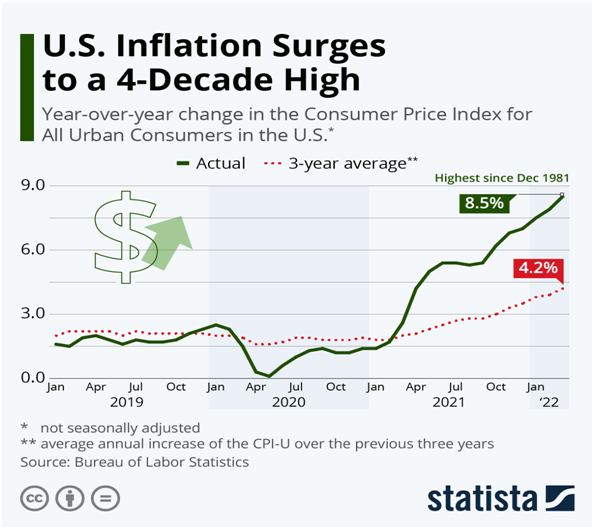
While inflation has costs for necessities, such as gas and food items, skyrocketing to an average of 8.5% in March and much higher for the aforementioned items – Social Security saw fit to only increase the Income Benefit to SSI recipients to 5.9%. Seniors, many of whom are subsisting on fixed incomes, might be able to cut their need for gasoline, but I do not know any who can get by without food, shelter, and electricity. Many are struggling to pay their bills already, and inflation shows little sign of abating.  

This was only until 09/2021, at which time, apparently only apples inflated lower than our current rate of inflation. 

But how about the argument that all this inflation is due to Putin and the war in Ukraine? Russia launched a full-scale assault on Ukraine February 22. One month after the end of the timeline in the chart below. 

When was our current president inaugurated? . . . Answer: January 20, 2021. Take a look at the green line above charting the Consumer Price Index on that date. (I will leave it at that.) 

To add insult to injury, the Centers for Medicare and Medicaid Services (CMS) increased Part B (outpatient care) premiums by 15% to a base premium -for those with an annual income of less than or equal to $91,000 – to $170.10 per month. Thank you very much!  

However, as described in Feature Article 1 below, due in part to a 50% cut in the cost of a $56,000 Part D covered drug, CMS is considering reducing that Part B Premium. My experience is that the government seldom gives back what they are already receiving . . . but one can only hope. 

For those involved in Marketplace medical coverage – health insurance for individuals and families under the age of 65 – the opposite action on the part of the Department of Health and Human Services may occur. Specifically, the extended enhanced premium tax credits made available by the American Rescue Plan, which enabled an additional 3 million Americans to receive a subsidy lowering their net monthly premium to as low as $0, are set to expire at the end of the year. As described in Feature Article 3 below, it is estimated 4.9 million more people will go uninsured if enhanced benefits are not extended. Never mind it is estimated the extension of such would increase the federal deficit by $305 billion dollars. Of course, the Treasury can simply print more money, further increasing inflation and diminishing the buying power of one’s paycheck or Social Security Income. 

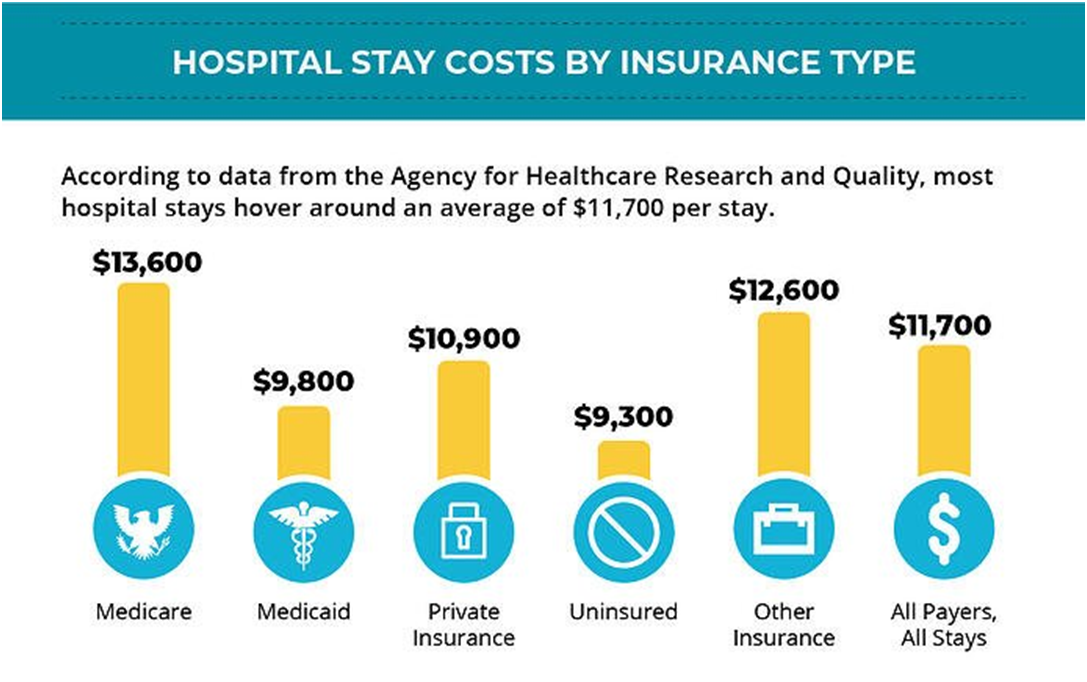
Lastly, medical expenses are no exception to inflation. If you wonder why health insurance premiums or out-of-pocket costs for healthcare are being affected, refer to article 3 below. They start high and increase as one goes from a doctor’s office to an Urgent Care facility to a hospital emergency room. Avoid the latter unless it is a true emergency because it will cost an average of $444 for low to moderate severity treatment. Heaven, forbid you have an overnight stay in a hospital without medical insurance because the average cost is $11,700. As cited in the chart below, it only goes up depending on the type of insurance you have. 

 Should your stay extend to three days, expect to cost to be an average of $30,000. And what if you don’t have health insurance? Here are the average costs of various treatments.

Take a look at what you might pay for each hospital bill without insurance: 

 *(Data from the Agency for Healthcare Research and Quality) 

While I cannot guarantee we have seen the worst of inflation – let alone that the government is going to provide us any meaningful relief in the immediate future. But I am here to assist you in acquiring medical coverage, which gives you access to the care and treatment you need to regain or preserve your health without being financially ruined. I will do my best to help you maintain access to as many of your preferred medical doctors and hospitals as the present market allows. I do not charge a fee for my services. There is no additional cost for the insights and value of my 36 years of experience in the health and Medicare-related insurance market. Neither is there any additional cost in acquiring an insurance product through me than if you walked through the door of your preferred insurance company and purchased their product directly from them. There is no obligation to take my learned advice.  

Please give me a call and let’s discuss your situation before the very busy “Open Enrollment” Periods are upon us and everyone is scrambling to mitigate what are almost certain to be the increasing costs of health care

.

Office: 291-367-6565 Text my cell 24/7 @ 713-907-7984 Email: Allplanhealthinsurance.com@gmail.com Https://TheWoodlandsTXHealthInsurance.com Https://Allplanhealthinsurance.com 

*********************************************************************************************************

FEATURED ARTICLE 1 

FIERCE HEALTHCARE 

CMS, FDA present united front against criticism of Aduhelm coverage decision 

AHIP applauded CMS for covering the drug and “related services such as PET scans if required b the trial protocol.” 

Other stakeholders said that now the coverage decision has been finalized it is time for CMS to take action on lowering Part B premiums. 

CMS has yet to announce any final decision on Part B premiums, which is increased by 15% for 2022. A key reason was the $56,000 price tag for Aduhelm. 

However, Department of Health and Human Services Secretary Xavier Becerra announced in January that the agency was rethinking the 15% hike after Biogen halved the price of Aduhelm in December.  

Becerra told reporters on Tuesday before the coverage decision that he was waiting to see what “CMS gives back to us in terms of their assessment and then once we get that information we will see where we go.” 

 CMS told Fierce Healthcare on Friday that it has yet to decide on a redetermination for the premium. 

But advocates are hoping the agency moves faster on scaling back the premium hike. 

“Medicare beneficiaries struggling to pay their bills need relief from this year’s premium increase as soon as possible,” said Max Richtman, president and CEO of the National Committee to Preserve Social Security and Medicare. 

Pharma and Alzheimer’s disease patient advocacy groups slammed the decision, however, noting that it will hamper access to the drug. 

“CMS has further complicated matters by taking the unprecedented step of applying different standards for coverage of medicines depending on the FDA approval pathway taken, undermining the scientific assessment by experts at FDA,” said Nicole Longo, spokeswoman for the Pharmaceutical Research and Manufacturers of America, in a statement.

*********************************************************************************************************

FEATURED ARTICLE 2 

BENEFITSPRO.COM 

End to ACA tax credits could leave 3 million uninsured 

But extending the enhanced credits would increase the federal deficit by $305 billion over 10 years. 

By Alan Goforth | April 08, 2022 at 09:32 AM 


Congress would need to act by midsummer to give marketplaces, insurers and outreach programs time to prepare for the 2023 open enrollment period. 

More than three million people could lose insurance coverage if enhanced premium tax credits included in the American Rescue Plan expire at the end of this year, according to a new report from the Urban Institute. The American Rescue Plan Act of 2021 increased credits for Marketplace insurance coverage and extended eligibility to more individuals. 

“If Congress does not extend these benefits, marketplace enrollment will most likely fall and the number of people uninsured will increase,” said Jessica Banthin, senior fellow at the organization. “Our findings show that 4.9 million fewer people will be enrolled in subsidized Marketplace coverage in 2023 if the enhanced credits aren’t extended. This comes at a pivotal time when millions of people will be losing Medicaid as the public health emergency expires.

*********************************************************************************************************

FEATURED ARTICLE 3

 Average charges for 8 common procedures across ER, retail and urgent care settings 

Alia Paavola – Wednesday, March 30th, 2022  

In 2020, the median charge for a 30- to 44-minute new patient office visit ranged from $164 in a retail clinic to $234 in an urgent care center, according to a March report from Fair Health. 

For the report, Fair Health, an independent nonprofit focused on enhancing transparency of healthcare costs and health insurance information, analyzed billions of private healthcare claims records from its database. 

Below is the average charge for eight common procedures, as identified by CPT code, performed in retail, urgent care and emergency room settings: 

Retail 

  • Office outpatient visit 20-29 minutes (99213): $114 
  • Streptococcus test (87880): $36 
  • Immunization administration (90471): $33 
  • Office outpatient visit 30-39 minutes (99214): $159 
  • Office outpatient, new, 30-44 minutes (99203): $164 
  • Flu test (87804): $42 
  • Office outpatient, new, 15-29 minutes (99202): $131 
  • Flu vaccination (90686): $31 

Urgent care 

  • Office outpatient visit 30-39 minutes (99214): $232 
  • Office outpatient visit 20-29 minutes (99213): $174 
  • Office outpatient, new, 30-44 minutes (99203): $234 
  • Streptococcus test (87880): $43 
  • Office outpatient, new, 45-59 minutes (99204): $313 
  • Flu test (87804): $46 
  • Therapeutic, prophylactic or diagnostic injection (96372): $59 
  • Office outpatient visit, new, 15-29 minutes (99202): 178 

Emergency room 

  • Emergency department visit — high severity/life-threatening (99285): $1,262 
  • Emergency department visit — high/urgent severity (99284): $919 
  • Emergency department visit — moderate severity (99283): $624 
  • Electrocardiogram (93010): $54 
  • Single-view chest X-ray (71045): $58 
  • CT head/brain without contrast material (70450): $323 
  • Two-view chest X-ray (71046): $69 
  • Emergency department visit — low/moderate severity (99282): $444 

Go back

Your message has been sent

Warning
Warning
Warning
Warning.

MEDICARE FOR ALL? (AND “THE TOOTH FAIRY PROMISES A 2 YEAR TREASURY NOTE PAYING 10.7% UNDER YOUR PILLOW IN 2020)

OpEd by D. Kenton Henry                                                                                           01 October 2019  HealthandMedicare.com

       VS.                 

I listened to the recent Democrat Presidential Primary Debates, as I listen to the daily sound bites in the media, as candidates try unabashedly to outdo each other. They do this in terms of the massive give-aways they promise us if elected in 2020. They promise these things not just to citizens, but everyone within the border of the United States. My incredulity, upon hearing such, exceeds even those bounds.

Their original promise is “free healthcare for all”. Healthcare free of premiums, deductibles, and copays. Medicare is the vehicle. To which I must ask myself, “Do these people even know the costs involved in Medicare?” “Do they really believe Medicare pays everything?” They would have you believe as much. They are counting on your naivety and lack of familiarity with the subject.

What makes Medicare a convenient and acceptable form of medical coverage for millions of people 65 and older (or disabled for 24 months or more) is it working in conjunction with private insurance plans. That, and thousands of licensed and “Certified” agents and brokers, helping to deliver comprehensive medical coverage at an affordable price. It is a hybrid package that provides as complete protection as available. The insurance plans would not exist without Medicare and, by itself, Medicare leaves the recipient/member exposed to significant liabilities.

Do these candidates, and the average voter know that in 2019:

A hospital admission requires the Medicare member to pay a $1,364 deductible each time they are admitted to the hospital as an inpatient for a separate medical condition, or the same medical condition separated by more than 60 days.

For days beyond 60, they pay $335 per day

Beyond day 90, they pay $682 per day

Eventually― say in the event of a stroke, paralysis, or being severely burned―they will pay all costs.

Part B Co-Insurance, Deductible and Premium

Relative to out-patient medical care, the Medicare member pays 20%, plus can be liable for excess charges above and beyond what Medicare deems “reasonable and customary”.

In addition, Medicare recipients pay an annual deductible of $185 for Medicare Part B (out-patient) medical care and a premium generally beginning at $135.50 per month and increasing to as high as $460.50. The latter depending on one’s adjusted gross income.

Perhaps most important, to take note of, in considering whether “Medicare For All” is even feasible, much less cost effective, is this. Medicare recipients have paid into the Medicare program their entire working careers via Medicare care taxes and payroll deductions. To qualify for Part A, (inpatient) coverage, they must have worked a minimum of 40 quarters or “buy in “with a premium as high as $422 per month.

So, you can see, Medicare is hardly free. And yet these candidates would have you believe it will be provided free of premiums, deductibles, and copays. (Now this is where even The Tooth Fairy raises her eyebrows!) It will be GIVEN, not to just those over 65, but to every man, woman, child, legal, and non-legal citizen or resident of the United States―whether they have paid a dime into the system or not.

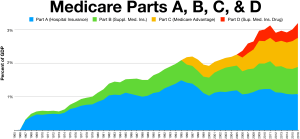
Factor all that in and process this. Medicare now spends an average of about $13,600 a year per beneficiary, and in five years, the annual cost is expected to average more than $17,000, the report said.

According to CMS.gov (The Centers for Medicare & Medicaid Services ― refer to featured article 1 below*) The Medicare Board of Trustees predicts Medicare’s two trust funds, for Part A and Part B and D, respectively ― will go broke in 2026!

To put things in perspective, in 1960 there were about five workers for every Social Security beneficiary. The ratio of workers to beneficiaries fell to 3.3 in 2005 and then to 2.8 in 2016. It will decline further to about 2.2 by 2035, when most baby boomers will have retired, officials said.

The aging of the population is another factor in the growth of the two entitlement programs. The number of Medicare beneficiaries is expected to surge to 87 million in 2040, from 60 million this year, according to Medicare actuaries. And the number of people on Social Security is expected to climb to 90 million, from 62 million, in the same period.

The United States Treasury: U.S. Debt And Deficit Grow As Some See Government As The “BeAll and EndAll”.

All this and the candidates would have you believe our government can provide free health care to everyone? When it can’t even provide it to our current citizens who have paid into the system their entire working lives! And who exactly is the government? “We The People”. We the tax payers. You and I. Even some of the candidates, admit the proposal will call for more taxes from the middle class. More? Really! One projected cost for Medicare For All is 39 trillion dollars over the first ten year period. The national debt is currently $22 trillion and took since the end of President Andrew Jackson’s administration (1837 and the last time the national debt was fully paid-off) to accumulate that! The combined wealth of all American households is less than $99 trillion. One can only conclude that “Medicare For All” would be a “Welfare System For All”. It would push our country into a socialist economic system to a depth from which it would be impossible to extricate itself.
As a new Medicare recipient, myself, I find the combination of the government program and private insurance working very well for myself and clients, from an insured standpoint. The program’s, and our nation’s, fiscal concerns are a more substantial matter and a topic for another time. With Medicare “Open Enrollment” a mere 15 days away, I can only say, “I hope whoever is President, and controls Congress, in future administrations―while providing a safety net for all American citizens―first and foremost, provides the capable, responsible, American taxpayer quality medical coverage―free of rationing of treatment and access to providers. At an affordable cost.”

D. Kenton Henry, editor HealthandMedicareInsurance.com, Agent, Broker

Email: Allplanhealthinsurance.com@gmail.com https://TheWoodlandsTXHealthInsurance.com https://Allplanhealthinsurance.com https://HealthandMedicareInsurance.com 


Go back

Your message has been sent

Warning
Warning
Warning
Warning

Warning.

************************************************************************************Featured article:

Centers for Medicare & Medicaid Services

Press release

Medicare Trustees Report shows Hospital Insurance Trust Fund will deplete in 7 years

Apr 22, 2019 

Medicare Trustees Report shows Hospital Insurance Trust Fund will deplete           in 7 years

Today, the Medicare Board of Trustees released their annual report for Medicare’s two separate trust funds — the Hospital Insurance (HI) Trust Fund, which funds Medicare Part A, and the Supplementary Medical Insurance (SMI) Trust Fund, which funds Medicare Part B and D.

The report found that the HI Trust Fund will be able to pay full benefits until 2026, the same as last year’s report.For the 75-year projection period, the HI actuarial deficit has increased to 0.91 percent of taxable payroll from 0.82 percent in last year’s report. The change in the actuarial deficit is due to several factors, most notably lower assumed productivity growth, as well as effects from slower projected growth in the utilization of skilled nursing facility services, higher costs and lower income in 2018 than expected, lower real discount rates, and a shift in the valuation period.

The Trustees project that total Medicare costs (including both HI and SMI expenditures) will grow from approximately 3.7 percent of GDP in 2018 to 5.9 percent of GDP by 2038, and then increase gradually thereafter to about 6.5 percent of GDP by 2093. The faster rate of growth in Medicare spending as compared to growth in GDP is attributable to faster Medicare population growth and increases in the volume and intensity of healthcare services.

The SMI Trust Fund, which covers Medicare Part B and D, had $104 billion in assets at the end of 2018. Part B helps pay for physician, outpatient hospital, home health, and other services for the aged and disabled who voluntarily enroll. It is expected to be adequately financed in all years because premium income and general revenue income are reset annually to cover expected costs and ensure a reserve for Part B costs. However, the aging population and rising health care costs are causing SMI projected costs to grow steadily from 2.1 percent of GDP in 2018 to approximately 3.7 percent of GDP in 2038. Part D provides subsidized access to drug insurance coverage on a voluntary basis for all beneficiaries, as well as premium and cost-sharing subsidies for low-income enrollees.  Findings revealed that Part D drug spending projections are lower than in last year’s report because of slower price growth and a continuing trend of higher manufacturer rebates.

President Donald J. Trump’s Fiscal Year 2020 Budget, if enacted, would continue to strengthen the fiscal integrity of the Medicare program and extend its solvency.  Under President Trump’s leadership, CMS has already introduced a number of initiatives to strengthen and protect Medicare and proposed and finalized a number of rules that advance CMS’ priority of creating a patient-driven healthcare system through competition.  In particular, CMS is strengthening Medicare through increasing choice in Medicare Advantage and adding supplemental benefits to the program; offering more care options for people with diabetes; providing new telehealth services; and lowering prescription drug costs for seniors.  CMS is also continuing work to advance policies to increase price transparency and help beneficiaries compare costs across different providers.

The Medicare Trustees are: Health and Human Services Secretary, Alex M. Azar; Treasury Secretary and Managing Trustee, Steven Mnuchin; Labor Secretary, Alexander Acosta; and Acting Social Security Commissioner, Nancy A. Berryhill. CMS Administrator Seema Verma is the secretary of the board.

The report is available at https://www.cms.gov/Research-Statistics-Data-and-Systems/Statistics-Trends-and-Reports/ReportsTrustFunds/index.html.

***************************************************************************************************

*Featured Article #2

Politics

Health insurers ramp up lobbying battle against Medicare-for-all

By Ana Radelat

The CT Mirror |

Aug 12, 2019 | 6:00 AM

Health insurers have joined forces with their longtime foe, the pharmaceutical industry, as well as partnering with the American Medical Association and the Federation of American Hospitals, to form a coalition to fight Medicare-for-all proposals and other Democratic plans to alter the nation’s health care.

As Democratic presidential candidates embrace changes to the nation’s health care system that could threaten Connecticut’s health insurers, the industry is hitting back.

Health insurers have joined forces with their longtime foe, the pharmaceutical industry, as well as partnering with the American Medical Association and the Federation of American Hospitals, to form a coalition to fight Medicare-for-all proposals and other Democratic plans to alter the nation’s health care.

The Partnership for America’s Health Care Future, funded by the insurance industry and its allies, is running digital and television ads aimed at undermining support for Medicare-for-all proposals and plans for a “public option,” a government-run health plan that would compete with private insurance plans.

The partnership was formed a little more than a year ago to protect the nation’s current health care programs, mainly the Affordable Care Act, Medicare and Medicaid.

[Politics] Returning home, Connecticut House members defend their support of impeachment inquiry »

The organization’s executive director, Lauren Crawford Shaver, said diverse groups in the coalition found a common cause in 2017 — opposing an attempt by congressional Republicans to repeal the Affordable Care Act.

“We came together to protect the law of the land,” she said.

That battle was won. Coalition members determined they should continue to band together to ward off other political dangers.

“There’s a lot of things we might fight about, but there’s a lot we can agree on,” Crawford Shaver said.

Sens. Bernie Sanders of Vermont and Elizabeth Warren of Massachusetts have called for a Medicare-for-all through a single-payer system, in which all Americans would be enrolled automatically in a government plan.

[Politics] Capitol Watch Podcast: As an older worker in Connecticut, what’s it like trying to find a new job? Here’s what we learned. »

Warren was among several candidates during the most recent Democratic debates who took aim at health insurers.

“These insurance companies do not have a God-given right to make $23 billion in profits and suck it out of our health care system,” she said.

Other candidates prefer a more modest approach, offering a “public option” or Medicare buy-in plan that would allow Americans to purchase government-run coverage, but unlike Medicare-for-all would not eliminate the role of private insurers.

That split among Democrats also runs through Connecticut’s congressional delegation, with Sen. Richard Blumenthal, D-Conn., and Rep. Jahana Hayes, D-5th District, endorsing Medicare-for-all plans and the other lawmakers supporting Medicare buy-in or public option plans.

The nation’s health insurers oppose all of the Democratic proposals discussed during the two nights of debates.

[Politics] Ghost gun ban, higher minimum wage and 9 other laws that go into effect Oct. 1 »

The insurers’ message is simple: The Affordable Care Act is working reasonably well and should be improved, not repealed by Republicans or replaced by Democrats with a big new public program. Further, they say, more than 155 million Americans have employer-sponsored health coverage and should be allowed to keep it.

Insurers also say that public option and Medicare buy-in plans would lead the nation down the path of a one-size-fits-all health care system run by bureaucrats in Washington D.C.

Advertisement

They say offering a public option or a Medicare buy-in would prompt employers to drop coverage for their workers and starve hospitals, especially those in rural areas, since government-run health plans usually reimburse doctors and hospitals less for medical services than private insurers. They also say Medicare-for-all and other Democratic proposals will lead to huge tax increases to pay for the plans.

“Whether it’s called Medicare for all, Medicare buy-in or the public option, the results will be the same: Americans will be forced to pay more and wait longer for worse care,” said Crawford Shaver.

The Partnership for America’s Health Care Future ran its first television ad on CNN just before and after the cable channel ran last week’s debates.

[Politics] Quinnipiac Poll shows growing support for impeaching Trump as news of whistleblower’s complaint sinks in »

The commercial showed several “ordinary Americans” at home and work decrying “one-size fits-all” health plans and “bureaucrats and politicians” determining care.

“We need to fix what’s broken, not start over,” the final speaker says.

Members of the Partnership for America’s Health Care Future have a lot of money and influence to wield on Capitol Hill. They spent a combined $143 million lobbying in 2018 alone, according to data from the Center for Responsive Politics.

And coalition members appear eager to spend even more lobbying money this year.

In the first six months of this year, America’s Health Insurance Plan, a health insurer industry group and member of the partnership, spent more than $5 million on lobbying expenses, and is on the way to surpassing the $6.7 million it spent in lobbying last year.

To underscore the health insurance industries’ importance to local economies, AHIP releases a state-by-state data book each year that details coverage, employment and taxes paid.

In Connecticut, the industry employs 12,296 workers directly and generates another 13,586 jobs indirectly, AHIP says. The payroll for both these groups of workers totals over $3.8 billion a year, AHIP says, and the average annual salary in the business is $112,770. The Connecticut Association of Health Plans puts the number higher, saying Connecticut has 25,000 direct jobs related to the health insurance industry, and another 24,000 indirect jobs.

AHIP also estimates that Connecticut collects nearly $200 million a year in premium taxes on health care policies sold in the state.

Connecticut’s reliance on health insurers – and their continuing influence – was on full display during the last legislative session when the insurance companies, led by Bloomfield-based Cigna, derailed

DENTAL INSURANCE: WORTH THE PREMIUM YOU PAY … OR SIMPLY A “TIME PAYMENT PLAN”?

Op-ed by D. Kenton Henry

“Is dental insurance really worth the premium I pay?” is one question I am asked frequently. It is often followed, almost instantly, by―”Or am I simply paying for my dental work on a time a payment plan?”

My answer to both questions is a definitive, “Maybe.”

If you, as the majority do, have dental insurance through your employer, that employer is subsidizing all or part of your premium. This convenience makes for a solution to the equation, more favorable to you. In contrast―if you are self-employed, retired, or otherwise personally have to pay the full amount of a dental insurance premium―the opposite may be true. That is unless you take some straightforward advice, I am about to provide. If you do not, you most likely will only be spreading your cost for dental work over time. Even worse, dental insurance could prove to be a “loss item” in that you will have paid more in premiums than you will ever receive in benefits.

Short of taking a long drive and crossing the Rio Grande into Mexico to obtain your dental work, what can you do to offset the cost of say, a dental implant, which, on this side of the border, is going to run from $3,500 to $7,000?

Let me preface this by with a premise or three:

#1) With no insurance company is “the sky the limit”. I’m referring to the fee they are going to pay a dentist for a particular dental procedure. For example, no insurance company is going to accept a fee of $10,000 for a single porcelain crown. Not even their share of that cost, which is typically 50%. So what is the limit of a fee the insurance company will cover? That limit must be contractually defined, and the limit most insurance companies abide by is, “reasonable and customary” or “reasonable, usual, and customary”. These are empirical standards an insurance company uses to determine whether to pay a fee. Or how much of a fee to pay. If the dentist charges the general prevailing rate in your geographical area, they are going to pay the portion for which they are contractually obligated. Basically, it’s the average charged in your neighborhood. You will be charged more in Beverly Hills, California and less in Brenham, Texas “where the cows think it’s heaven”. Additionally, if “usual” is part of the definition, the fee has to be in line with what this particular dentist charges for a particular procedure. If fee is disproportionate either, or, both, ways―the maximum amount paid by the insurance company will be the limit set in their fee schedule.

#2) A dental insurance plan is either a provider network plan or a non-network plan. If it is a network plan, it is usually either a Dental Preferred Provider Organization (DPPO) Plan or a Dental Health Maintenance Organization (DHMO) Plan. If it is the first, you may go outside the network of dentists with which the insurance company has contracted but will most likely pay a higher cost for doing so. With the latter, you must remain within the network of dentists or, you have no insurance coverage whatsoever. For either of these options, you pay a lower premium than if you purchase a non-network or “any dentist” plan. The reason is that you agree to utilize or, at least, consider utilizing a dentist with whom the insurance company has contracted to charge you a lower fee than they would without the contract. This limits the insurance companies losses and brings increased traffic to the dentist.

#3) This is perhaps the most important part. If you purchase a non-network dental insurance plan, you can, almost, be assured you will be charged more than the insurance company deems acceptable. Additionally, you will be responsible for any dollar amount above their “reasonable and customary” rate. However, if you purchase a network plan, and go within the network of dentists, you will not be held responsible for any “excess” charges. Any charges above the reasonable and customary rate, the dentist will be forced to “write off”. In this situation, you will never have to worry about a surprise bill or claim. If a policy says your share of the bill is 20% or 50%, it will be that and not 20% or 50% plus any excess charges.

Assuming you accept you must acquire a network plan, in order to limit you own losses and surprise dental bills, the challenge becomes, “How do you find a quality dentist willing to accept a lower fee for treating you?” The typical HMO dental provider is typically someone straight out of dental school or who otherwise needs to build their patient base. In return for sending patients their way, the dentist is willing to accept a meaningfully lower fee. If the dentist is a PPO provider, they may have been in business longer, have more experience, and perhaps a reputation for having better skills. But they are willing to accept a somewhat lower fee in return from the many employees a large company may send their way. The dentist who isn’t willing to participate in any network apparently feels they have all the clients they need. That or their reputation is so great it will draw all the traffic they require.

The problem is, unlike a large oil company, as an individual, or family, you don’t bring enough “volume” to the table to bargain for a lower dental fee. At least not by yourself. Therefore, you have to identify and purchase your dental insurance from an insurance company which has the reputation of insuring a large number of employees of that oil company. As well as having a reputation for paying their claims in a timely and efficient manner. A manner such that the dentist wants to be contracted with them. From your standpoint, you want that insurance company to have a reputation for the same when it comes to you and not have to worry about claim disputes.

Another challenge is, at $6,000 for a dental implant, your dental benefit may not go too far. Secondly, does your insurance plan cover implants in the first place? Again, the sky is not the limit. The average dental plan covers a maximum of $1,000 of dental treatment per year. You can pay a higher premium for incremental benefits up to a maximum of $5,000. But a policy which pays that much in year one would cost a fortune and there is typically a twelve-month wait for major dental work to be covered. As such, you may want to find a plan which increases to that limit with each passing year and is available at what you consider a reasonable cost.

How do you find a dental policy which does not subject you to “excess” costs; allows you to see a highly skilled dentist, utilizing the latest technology and performing the most advanced form of treatment; all at a competitive premium? And this from a company which pays the claims they are contractually obligated to pay while doing so in a timely fashion?

This is where I, and my thirty-three years experience in the medical and dental insurance business, come in. My experience as a patient and consumer is even longer. After being in braces for eight years, I had all my front teeth knocked out in an auto accident when they impacted the steering wheel. I was wearing a seat belt, which saved my life, but not a shoulder strap. I’ve had to have the dental work replaced on three occasions since that senior year of high school. This year, I proceeded with what will be one double crown and, ultimately, two implants. (Ouch, is right!) I was not willing to accept this type of work from a mediocre dentist―and certainly did not care to pay cash for it! So I found a policy, issued by a large, financially sound insurance company, with a reputation for excellent customer and claim service. Then I found a policy which ultimately pays the maximum $5,000 annual benefit. In order for it to be affordable to me, it started, December 1 of 2018, at a calendar year benefit of $1,500―immediately went to $2,500 January 1, of this year―and will go to a $5,000 benefit this coming January. So I only paid for a $1,500 benefit for one month before it jumped to a $2,500 benefit! During this year I acquired the double porcelain crown and the bone graft and post for one dental implant. In 2020, I will have the crown for the implant post attached, when my calendar year benefit is $5,000. The second implant is optional, and I will probably have that work done in 2021 when my benefit remains $5K.

Once I knew what company to go with, the final step in selecting my dental insurance policy required finding the right dentist. I reviewed the insurance company’s list of network providers and researched the dentist’s reputation via credentials and reviews. I won’t belabor that but, suffice it to say, I found a dentist who met my requirements. He is very conveniently located relative to any resident of The Woodlands or Spring and, in my opinion, is well worth going to if you reside anywhere in Montgomery County or Northwest Harris County. He utilizes the latest technology, has a great and skilled staff, and a decent, very professional, if not overly effusive, chairside manner.*

In summation, in order to make dental insurance worth your while, you need to:

1) accept you need to acquire a “network provider” dental plan

2) find a policy which pays a reasonable benefit based on your foreseeable need, at an affordable premium and

3) allows you to go to a skilled dentist convenient to you

I have done all the homework for you. For over three decades, I have specialized in medical, Medicare-related, and dental insurance. I provide objective quotes from established “A” rated companies and quality customer service. Among the companies I represent are Aetna, Ameritas, Anthem, BlueCross BlueShield, Cigna, Delta Dental, Humana, and UnitedHealthcare. I am located in the heart of The Woodlands and am accessible from my websites Allplanhealthinsurance.com and TheWoodlandsTXHealthInsurance.com. You may also feel free to contact me at my numbers below.

I look forward to working with and assisting you in acquiring any of the above referenced products.

D. “Kenton” Henry                                                                                                               Editor, Agent, Broker Office: 281-367-6565                                                           Text my cell @ 713-907-7984                          http://TheWoodlandsTXHealthInsurance.com                              http://Allplanhealthinsurance.com                                   http://HealthandMedicareInsurance.com https://linkedin.com/in/kentonhenryinsuranceconsultant

*(Neither I nor my agency and websites are affiliated in any way with a particular dentist or dental office. Neither do we receive compensation from the same for any recommendation we may make.)

Go back

Your message has been sent

Warning
Warning
Warning
Warning

Warning.

MEDIA WARNS CONSUMERS THEY WILL HAVE LESS HELP SHOPPING FOR 2019 HEALTH INSURANCE

(BUT THEY DIDN’T ASK ALL PLAN MED QUOTE OF THE WOODLANDS, TEXAS)

Navigators in a boiler room

By D. Kenton Henry Editor, Agent, Broker
29 October 2018

The media is proffering all manner of good news when it comes to the Open Enrollment Period for purchasing 2019 individual and family health insurance, just three days away. The doors open this Thursday, November 1st and will remain so through December 15th. During this time you, the consumer, will be able to review your options and make a decision to renew your existing policy or select a new one to become effective January 1. Whichever, that policy will cover you the coming calendar year.

The feature article appearing below, states there will be ” . . . fewer sources of unbiased advice and assistance to guide them through the labyrinth of health insurance.” To wit, it cites, the budget for insurance counselors, known as navigators, has been cut by 80%, leaving over one-third of navigators in 2,400 counties served by Healthcare.gov, unfunded. Thank you very much, New York Times. Somehow, they neglected to consult with me and my agency, ALL PLAN MED QUOTE. Reading the article in full, one can infer they feel the only meaningful assistance can come from the government (at taxpayers’ expense) and fail to credit the private industry, which has provided counsel and enrollment assistance within the domestic insurance industry some two hundred years plus. One token sentence in the article acknowledges the private industry’s presence to assist the consumer with procuring health insurance. In my estimation, this reflects the media’s general opinion and thesis that the government is the end-all solution to every conceivable personal financial issue. Which, again, in the mind of this editor, is precisely the philosophy, the perpetuation of which got us into this fix in the first place. Moreover, what exactly is that fix?

Current pre-midterm election media coverage informs us premiums have stabilized and are, in many cases, going down in 2019. While that may be true in some localities, the recently released premiums in southeast Texas reflect increases of 20% or more. If you obtain a subsidy, wherein you get a tax credit for a portion of your premium, the subsidy itself may be larger, but the balance may be as well. Also, for those not obtaining a subsidy (the vast majority of us) the increase will be born entirely by ourselves. The situation has made healthcare the number one concern of Americans heading into next week’s midterm elections according to a Fox News Poll.

For the record, ALL PLAN MED QUOTE and I have never been subsidized by taxpayer dollars. As an independent, self-employed broker/agent I am compensated when I successfully enroll someone in health insurance. I am not compensated when I fail at such. That is fine by me. In spite of continual cuts in agent compensation. I prefer autonomy to bureaucracy. My advice and guidance are objective. My goal is to succeed it getting you enrolled in a policy which makes sure you have access to the care and treatment you need, when you need it and are not financially devastated in the process. All this for the lowest possible premium. I do not care which insurance company you contract with, as long as you are satisfied you have obtained the best coverage for your given situation and needs. Ideally, it would also provide you access to all the doctors and medical providers you choose to utilize. Regrettably, that latter objective has become my biggest challenge and is one every insurance agent and counselor faces. To say it can be overcome in every instance would be misleading but I do my best. All 2019 individual and family options are Health Maintenance Organizations (HMO) policies, and this has been so since 2016. The HMO networks are narrow in comparison to what one may typically have experienced with employer-based HMO coverage. However, there are a very few plans (3 in my primary region) which operate very similar to a traditional Exclusive Provider Organization (EPO) policy in that they do cover treatment at a provider outside the network. Benefits are paid up to a limited percentage, and there is no cap on your maximum annual out-of-pocket but―for someone who wants to be assured they can obtain coverage from the provider of their choice―it is better than no coverage whatsoever. If you feel you must learn more about this option, please contact me.

To assist me in these ends, I am appointed with every company providing Patient Protection and Affordable Care Act-compliant health insurance company doing business in Montgomery, Harris, Fort Bend, and Galveston counties. BlueCross BlueShield of Texas (to my knowledge) does business in every corner of Texas, and I have been appointed with them twenty-seven years. In addition to Texas, I am licensed in Indiana, Michigan, and Ohio.

I offer short-term health insurance for those who do not get a subsidy and those who, whether they do or not, cannot afford credible health insurance. However, I do not represent it as covering pre-existing health conditions, as it does not. Nor do I represent it as a substitute for credible, compliant coverage. It is a short-term bridge to a long-term solution.

As always, the Open Enrollment Period will be a very busy and hectic time for anyone in my profession. To make things proceed more smoothly, I would appreciate you visit my quoting site to obtain spreadsheet comparison of your options from all the health insurance companies offering coverage in your county. Attempt to narrow your selection down to those plans you feel most closely approximate the coverage you need. You can search for in-network providers from the search button directly next to the premium quoted. If you are so confident a plan is right for you, please feel free to apply straight from the quote. However, many of you will have questions or appreciate my insight and experience with the plan details and application process. Those in need of a subsidy will find my assistance especially helpful. If this is you, please do not hesitate to contact me.

Again, for quotes and applications, you may go to my website at Http://TheWoodlandsTXHealthInsurance.com and click on “Health” in the top menu.

Alternatively, you may go directly to my spreadsheet quotes and an application by clicking on this link:
https://allplanhealthinsurance.insxcloud.com
*(it is not necessary to log in or register to obtain quotes or apply)

If you already know your interest is a policy from BlueCross BlueShield of Texas, you may go directly to their quoting and application page by clicking here:
https://retailweb.hcsc.net/retailshoppingcart/TX/census?ExpressLinkedAgentId=2V0boERIKNxDSESKunpc/w==

**(if these links do not function from this text, please copy and paste or type in your browser and hit enter)

If you apply for coverage through these links, I will be your agent and available to assist and commit to providing the best of service throughout the year. I bring my entire thirty-two years in medical insurance to bear for this purpose. I look forward to hearing from you and assisting you. Regardless, I hope you succeed in obtaining health insurance which suffices until Congress puts their heads together and provides us with more reasonable options.

D. Kenton Henry                                                                                                              All Plan Med Quote                                                                                                    Office: 281.367.6565                                                                                                     Text my cell @ 713.907.7984                                                                                   Email: Allplanhealthinsurance.com
For the latest in health and Medicare-related insurance, news go to Https://HealthandMedicareInsurance.com

COMMENTS OR QUESTIONS:

Go back

Your message has been sent

Warning
Warning
Warning
Warning

Warning.

************************************************************************************************
FEATURED ARTICLE 

The New York Times
By Robert Pear
Oct. 27, 2018

Shopping for Insurance? Don’t Expect Much Help Navigating Plans

Affordable Care Act navigators helping patients during an enrollment event in 2016 at Southwest General Hospital in San Antonio.CreditCreditEric Gay/Associated Press
WASHINGTON — When the annual open enrollment period begins in a few days, consumers across the country will have more choices under the Affordable Care Act, but fewer sources of unbiased advice and assistance to guide them through the labyrinth of health insurance.
The Trump administration has opened the door to aggressive marketing of short-term insurance plans, which are not required to cover pre-existing medical conditions. Insurers are entering or returning to the Affordable Care Act marketplace, expanding their service areas and offering new products. But the budget for the insurance counselors known as navigators has been cut more than 80 percent, and in nearly one-third of the 2,400 counties served by HealthCare.gov, no navigators have been funded by the federal government.
“There is likely to be a lot of consumer confusion about the various plan options that may be available this year,” said Sabrina Corlette, a research professor at Georgetown University’s Health Policy Institute. “It will be a bit of a Wild West — buyer beware!”
“Obamacare health plans,” short-term plans and “Christian health sharing plans” are all displayed on the same page of some shopping sites like Affordable-Health-Insurance-Plans.org, which describes itself as a free referral service for insurance shoppers.
ADVERTISEMENT
Consumers may have difficulty sorting through their options after the administration sliced the budget last summer for insurance navigators to $10 million this year, from $36 million in 2017 and nearly $63 million in 2016.
“Navigators play a vital role in helping consumers prepare applications to establish eligibility and enroll in coverage through the marketplaces,” the Department of Health and Human Services says on its website.
But 797 counties served by HealthCare.gov will not have any navigators this year, according to a tabulation of federal data by the Kaiser Family Foundation. That is a sharp increase from 2016, when 127 counties lacked such assistance.
“If you are confused and you want somebody’s help to try to figure out what’s right for you — what’s junk and what is legitimate — there will be fewer people to help you in most states,” Ms. Corlette said.
Federal officials said they were not providing funds for navigators in Iowa, Montana or New Hampshire because no organizations had applied for the money in those states.
Cleveland, Dallas and large areas of Michigan and other states will also be without navigators.
Texas will be hit hard. The state has the largest number and the highest percentage of people who are uninsured, with 4.8 million people, or 17 percent of residents, lacking coverage, according to the Census Bureau.
“North Texas remains one of the most uninsured areas in the country,” said the chief executive of Dallas County, Judge Clay Lewis Jenkins. “The administration’s decision to defund all navigators across North Texas will hurt our ability to enroll individuals in health insurance and result in some working families losing coverage. Only 45 of Texas’ 254 counties have any navigator coverage.”
Seema Verma, the administrator of the Centers for Medicare and Medicaid Services, defended the cuts.
After five years, she said, “the public is more aware of the options for private coverage” available through the marketplace, so “it is appropriate to scale down the navigator program.” In addition, she said, information and assistance are available from other sources, including insurance agents and brokers.
Consumers can sign up for health insurance under the Affordable Care Act starting Thursday. Last year, 8.7 million people enrolled at HealthCare.gov, and three million more selected plans on insurance exchanges run by states.
Consumers can go without insurance next year without fear of a penalty, as Congress repealed the unpopular tax surcharge imposed on people who lack coverage.
Many health policy experts say that federal financial assistance is more important than the individual mandate in inducing people to buy insurance. Those subsidies will still be available to low- and moderate-income people for insurance that complies with the Affordable Care Act and is purchased through the public marketplace. The subsidies cannot be used for short-term policies.
The vast majority of the people we serve, over 90 percent, are motivated to have insurance because they want coverage for their family and themselves,” said Matthew Slonaker, the executive director of the Utah Health Policy Project, a nonprofit. “It’s not because they otherwise would have to pay a penalty.”
Average premiums for the most popular types of insurance purchased by individuals and families will be relatively stable next year and, in some states, will actually decline, the administration says.
Under new standards issued by the administration, navigators this year are encouraged to inform consumers of the full range of coverage options, including short-term plans that do not provide all of the benefits and consumer protections required by the Affordable Care Act.
President Trump has promoted the short-term policies as an inexpensive alternative to the Affordable Care Act, and he said those plans would be “much more widely available” as a result of an executive order he signed last year to overturn restrictions imposed by President Barack Obama.
Democrats have made health care a major theme in midterm election campaigns, and they say the short-term policies show how the Trump administration threatens protections for people with pre-existing conditions.
Short-term policies, which can extend up to 364 days and then be renewed for two additional years, often provide no coverage for pre-existing conditions, prescription drugs, pregnancy, maternity care or the treatment of mental disorders and drug abuse.
Indeed, Mr. Trump said, the short-term plans are cheaper because they are “not subject to any very expansive and expensive Obamacare coverage mandates and rules.”
ADVERTISEMENT
But, said Kirsten A. Sloan, a vice president of the American Cancer Society Cancer Action Network: “People may be attracted to short-term plans without understanding that the lower premiums come with less coverage. These plans may not cover the doctors and hospitals and drugs you need if you get sick.”
In another challenge this year, consumers may be deluged with robocalls offering cheap insurance.
Alex Quilici, the chief executive of YouMail, a company that offers software to combat robocalls, said he was seeing a huge increase in health insurance scams.
“Callers say ‘it’s open enrollment’ or ‘we can get you a better deal by looking at all the health insurance plans,’” Mr. Quilici said. “Callers ask for lots of personal information, and the unwitting consumer often gives their birth date, Social Security number and information for everybody in the family, in order to get a great deal. In reality, it’s identity theft or payment theft or both.”
Mr. Quilici’s company has recorded hundreds of robocalls. A typical call says that, with enrollment just “around the corner,” Mr. Trump has created short-term coverage options lasting up to three years, “so you and your family can get a great insurance plan at the price you can afford.”
It is difficult to identify the source of the robocalls, Mr. Quilici said, because callers often falsify information displayed on caller ID.
(A version of this article appears in print on Oct. 27, 2018, on Page A25 of the New York edition with the headline: Shopping for Health Insurance: Many Options but Little Guidance. Order Reprints | Today’s Paper | Subscribe)