NAVIGATING THE FRUSTRATIONS OF FINDING INDIVIDUAL AND FAMILY HEALTH INSURANCE

By D. Kenton Henry
Editor, Agent, Broker

Finding Your Doctor and Understanding Subsidies in HMO Plans

Shopping for individual or family health insurance can feel like navigating a maze—with dead ends, confusing signs, and few clear answers. Two of the most common pain points for shoppers are (1) trying to keep your current doctor while limited to an HMO network and (2) figuring out whether you qualify for a subsidy, known as an advance premium tax credit (APTC). Both challenges can make the process frustrating and overwhelming, especially during open enrollment when time is limited.

One of the biggest shocks people face when shopping for health insurance is realizing that their trusted doctor or medical provider might not be covered under a new plan—especially if it’s an HMO (Health Maintenance Organization). Unlike PPOs (Preferred Provider Organizations), which offer broader provider access and out-of-network options, HMO plans restrict coverage to a specific network of doctors and hospitals. If your doctor isn’t in the network, you may have to pay the full cost of your visit out of pocket—or switch doctors entirely.

  • Outdated or Inaccurate Provider Directories: Online directories can be incomplete or outdated. It’s not uncommon for a provider to be listed as “in-network” only for you to find out later they’ve left the plan.
  • Hard-to-Navigate Insurance Websites: Many insurance carrier sites don’t make it easy to search by doctor name, location, or specialty. Even worse, each plan may have its own “network tier,” adding another layer of complexity.
  • No Universal Search: There’s no centralized tool that lets you enter your doctor’s name and see every marketplace plan that includes them. You have to check each insurance company or plan individually.

For people with ongoing care needs—like managing chronic conditions or continuing with a trusted pediatrician or specialist—the possibility of switching providers isn’t just inconvenient, it can feel risky.

The Affordable Care Act (ACA) made health insurance more accessible by offering subsidies for people who meet certain income guidelines. These subsidies, officially called advance premium tax credits, lower your monthly premium based on your household size and income.

The good news is that many people qualify.

The bad news is that determining whether you qualify can feel like filling out a tax return just to get a quote.

  • Income Guesswork: Subsidy eligibility is based on your estimated household income for the upcoming year. That’s right—you must predict your future income, even if you’re self-employed or work variable hours.
  • Family Dynamics Matter: Your household size includes dependents—even if they don’t need insurance—and income from every working member. This means getting it right often requires gathering data from multiple people.
  • Mid-Year Changes Complicate Things: If your income or family size changes mid-year, you may need to report it or risk having to repay part of your subsidy at tax time.
  • The ACA “Cliff” and “Glide Path”: Previously, you could lose your subsidy entirely if your income was even $1 over the limit. Recent changes have smoothed this out, but they are still complicated and frequently misunderstood.

And while tools like Healthcare.gov’s calculator are helpful, they often rely on broad estimates. They can’t account for all variables, such as gig work, investment income, or multiple part-time jobs.

When you shop for health insurance, you’re not just picking a product—you’re making decisions that affect your finances, your family’s well-being, and your access to care. The stakes are high, yet the process often feels opaque and unnecessarily complicated.

  • Compare dozens of plans with unfamiliar terms,
  • Check if your providers are covered (without reliable tools),
  • Predict your income a year in advance,
  • And hope you don’t make a mistake that costs you money or coverage.

While the system isn’t perfect, there are ways to reduce frustration:

  • Use a Licensed Agent or Broker: Agents specializing in ACA plans can often help you find plans that include your provider and determine if you qualify for subsidies—all at no extra cost.
  • Call Your Doctor’s Office: Don’t rely solely on insurance directories. Call your provider’s office directly to confirm if they accept a specific plan.
  • Keep Documentation: If your income fluctuates, keep clear records. This will help you provide accurate estimates and support your case in the event of an audit or dispute.
  • Update Changes Promptly: If your income or household size changes mid-year, report it on your health insurance marketplace to avoid surprise bills or tax penalties.

Shopping for individual or family health insurance can be a stressful process—especially when you’re trying to keep your doctor and figure out if you qualify for financial help. Between restrictive HMO networks and confusing subsidy rules, it’s easy to feel stuck. But with a little extra diligence, some expert help, and the right questions, you can find a plan that fits your needs without sacrificing peace of mind.

If the process still feels overwhelming, you’re not alone. Many Americans share the same frustrations—and continue to hope for a more user-friendly system in the future.

Below is a chart outlining estimated income thresholds for qualifying for an Advance Premium Tax Credit (APTC) in 2025. These thresholds are based on a percentage of the Federal Poverty Level (FPL), which is adjusted annually. For simplicity, the chart includes 2024 FPL figures (used for 2025 coverage) and the income ranges (100%–400%+ of FPL) where most people qualify for subsidies under the ACA.

📝 Note: Due to the American Rescue Plan and Inflation Reduction Act, subsidies may extend beyond 400% of the FPL, with a sliding scale that caps the percentage of income spent on premiums. These extended subsidies are currently in place through 2025.

Household Size100% / FPL400% / FPLTypical APTC Eligibility Range

1 (Individual) $14,580 / $58,320 / $14,580 – ~$58,000+

2 (Couple) $19,720 / $78,880 / $19,720 – ~$79,000+

3 $24,860 / $99,440 / $24,860 – ~$99,000+

4 (Family) $30,000 / $120,000 / $30,000 – ~$120,000+

5 $35,140 / $140,560 / $35,140 – ~$141,000+

6 $40,280 / $161,120 / $40,280 – ~$161,000+

  • Minimum Income: You must earn at least 100% of the FPL to qualify for a subsidy in most states. In Medicaid expansion states, if you earn less than 138% FPL, you may qualify for Medicaid instead.
  • Upper Limit Removed: Thanks to temporary reforms, people earning above 400% FPL may still qualify for a subsidy if the cost of the benchmark plan exceeds ~8.5% of their income.
  • Household Size: Includes you, your spouse, and any dependents claimed on your tax return.
  • If your estimated annual income falls between the ranges shown above, you likely qualify for help paying your monthly health insurance premium.
  • Households earning more than 400% of the FPL may still qualify if their premiums exceed about 8.5% of income, thanks to current federal subsidy expansions.
  • Eligibility is based on your tax household — including you, your spouse, and dependents you claim on your tax return.
  • If your income is below 138% FPL, you may qualify for Medicaid (in most states).

DO NOT CALL AN 800 NUMBER and talk to some anonymous employee of an insurance company. Not only are they restricted to limiting you exclusively to their company’s options—but your personal information will be instantly sold and shared. Your phone is going to begin ringing off the hook!

I’ve been specializing in Medicare-related insurance for over thirty years, right here in The Woodlands, Texas, USA! I represent every Medicare-related product, including Supplement, Advantage, and Part D Drug plans, from virtually every “A” rated company doing Medicare-related business in Texas. And I CHARGE NO FEE for my services! Deal with a local agent/broker who values your business enough not to share it with anyone!

D. Kenton Henry
Editor, Agent, Broker
Office: 281.367.6565
Text my cell 24/7 @713.907.7984
Email: Allplanhealthinsurance.com@gmail.com

Leave a comment

https://www.woodlandsonline.com/blps/article.cfm?page=14062
Https://TheWoodlandsTXHealthInsurance.com
Https://Allplanhealthinsurance.com
https://healthandmedicareinsurance.com/2025/03/20/congratulations-youre-turning-age-65-and-eligible-for-medicare-whats-next/?fbclid=IwY2xjawJKSbBleHRuA2FlbQIxMQABHQbe0u7yebhaHWAa_6axQnzaMdTi9mM6TUvKICB6PZT-xV45uXovIMtEog_aem_0lPN3F7TsqV6X7pjJLvLJg

CONGRATULATIONS! YOU’RE TURNING AGE 65 AND ELIGIBLE FOR MEDICARE! (WHAT’S NEXT?)

Congratulations! You’ve worked hard, and now you’re turning age 65!
Navigating through the myriad of solicitations you are receiving and
the choices you have to cover the expenses not paid by Medicare can be overwhelming.

The first thing is what not to do!

DO NOT CALL AN 800 NUMBER and talk to some anonymous employee of an insurance company. Not only are they restricted to limiting you exclusively to their company’s options—but your personal information will be instantly sold and shared. Your phone is going to begin ringing off the hook!

I’ve been specializing in Medicare-related insurance for over thirty years, right here in The Woodlands, Texas, USA! I represent every Medicare-related product, including Supplement, Advantage, and Part D Drug plans, from virtually every “A” rated company doing Medicare-related business in Texas. And I CHARGE NO FEE for my services! Deal with a local agent/broker who values your business enough not to share it with anyone!

D. Kenton Henry
Editor, Agent, Broker
Office: 281.367.6565
Text my cell 24/7 @713.907.7984
Email: Allplanhealthinsurance.com@gmail.com

Leave a comment

https://www.woodlandsonline.com/blps/article.cfm?page=14062
HealthandMedicareinsurance.com
TheWoodlandsTXHealthInsurance.com
Allplanhealthinsurance.com
https://www.woodlandsonline.com/blps/article.cfm?page=14067

UNDER AGE 65 2024 INDIVIDUAL AND FAMILY HEALTH INSURANCE ENROLLMENT BEGINS NOVEMBER 1

(WHAT YOU NEED TO KNOW)

By D. Kenton Henry, editor, agent, broker

22 October 2023

Ever since the passage of the Patient Protection and Affordable Care Act (ACA), commonly referred to as “Obamacare”, in 2010, the Department of Health and Human Services has dictated when and under what circumstances an individual and family can apply for and obtain health insurance. This period is known as the Open Enrollment Period, and it is upon us. Each year, between November 1st and December 15th, U.S. citizens and their families may apply for and obtain health insurance effective January 1st of the coming calendar year. From then until January 15th, they may apply for coverage effective February 1st. Beyond that date, they are locked out of any health insurance plan they were not enrolled in when the year ended. Only special circumstances such as losing “creditable” coverage through no fault of their own, moving out of a plan’s area, birth of a child, or death of a covered family member allow them to apply for coverage beyond the Open Enrollment Period. And only if they were insured when the special circumstance occurred and no more than 60 days have passed. Creditable coverage meets all the mandates of the Affordable Care Act, such as guaranteed coverage for pre-existing health conditions, including pregnancy and mental health disorders, along with no out-of-pocket for preventative medicine. All coverage is guaranteed so long as the above requirements are met. 

If affordability of health insurance is an issue, Premium Tax Credits (subsidies) are available from the Department of Health and Human Services (DHS) to people or families whose income falls below a certain threshold. 

WHO IS ELIGIBLE FOR THE PREMIUM TAX CREDIT?  

To receive the premium tax credit for coverage starting in 2024, a Marketplace enrollee must meet the following criteria:

· Have a household income at least equal to the Federal Poverty Level (FPL), which for the 2024 benefit year will be determined based on 2023 poverty guidelines 

· Can not have access to affordable coverage through an employer (including a family member’s employer)

· Can not be eligible for coverage through Medicare, Medicaid, the Children’s Health Insurance Program (CHIP)

· Have U.S. citizenship or proof of legal residency (Lawfully present immigrants whose household income is below 100 percent FPL can also be eligible for tax subsidies through the Marketplace if they meet all other eligibility requirements)

· If married, must file taxes jointly

Income: For the purposes of the premium tax credit, household income is defined as the Modified Adjusted Gross Income (MAGI) of the taxpayer, spouse, and dependents. The MAGI calculation includes income sources such as wages, salary, foreign income, interest, dividends, and Social Security.

Your tax credit is based on the household income estimate you put on your Marketplace application. 

Income between 100% and 400% FPL: If your income is in this range (in all states) you qualify for premium tax credits that lower your monthly premium for a Marketplace health insurance plan. The lower your income is as a percent of the FPL—the higher your subsidy. 

The easiest way to determine whether and for how much you qualify is to call me. You will estimate your 2024 household’s adjusted gross income and my subsidy calculator will tell us (based on the number of people in your household) how much your subsidy will be. If we give the DHS the same information you give me, my calculations are usually accurate to within $3.00 of what you will actually receive. We then apply that subsidy against the premium of the plan you wish to acquire and arrive at your net premium. 

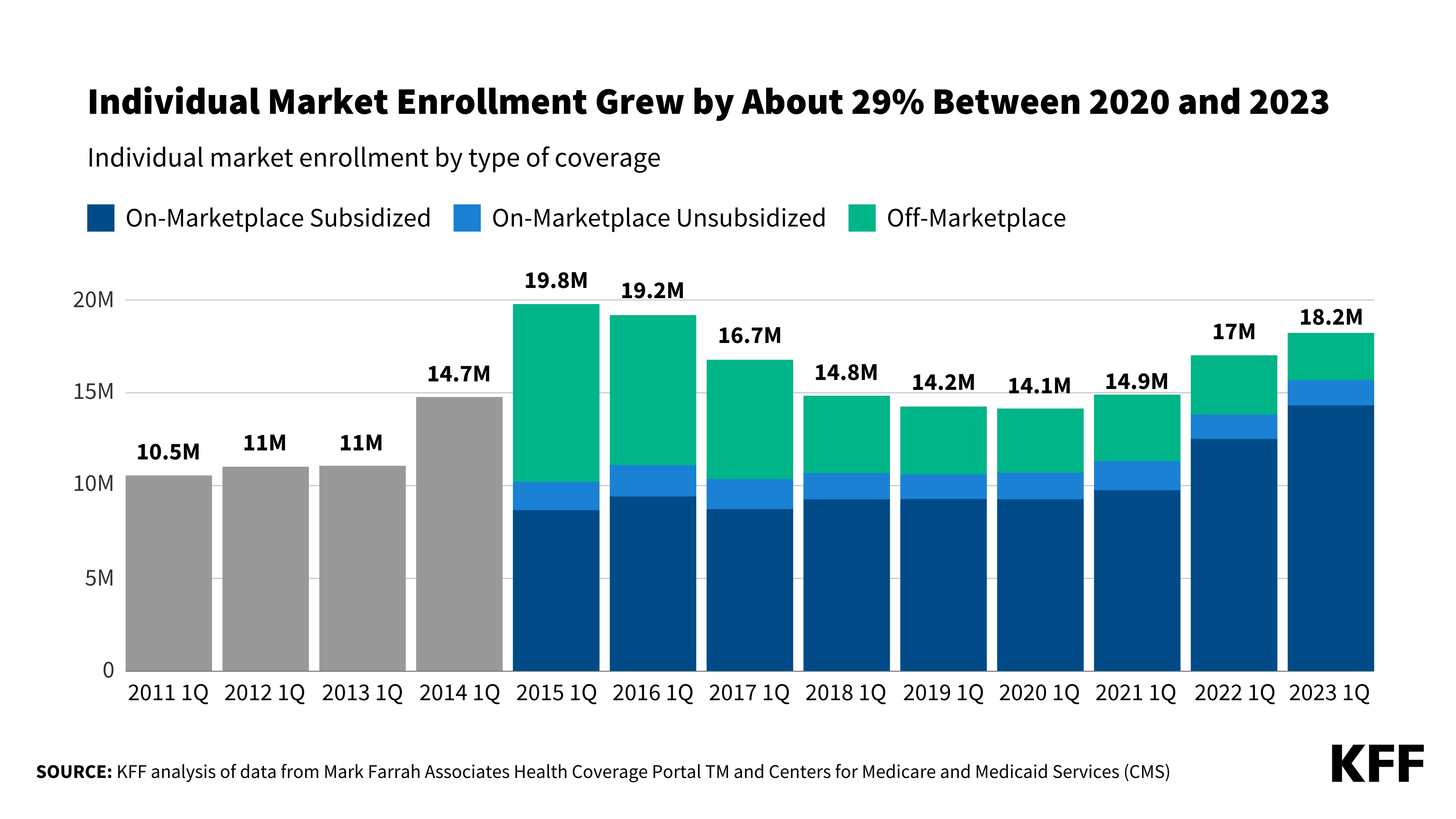
The number of people who qualify for subsidies continues to grow. For details on this, please refer to this chart and my feature article 2 below.

As to how much retail (gross) premiums are expected to grow from 2023 to 2024, estimates put the national average at 6%. (For the details on this, please refer to Feature Article 1 below.) Given the rate of core and real inflation, this should not come as a surprise. Acquisition of a subsidy will certainly offset ever-increasing premiums. 

As always, the greatest challenge to the consumer and their agent/broker is affordability or obtaining the desired benefits. Instead, it is finding their doctors in the networks of a health plan. In 2024, as it was this year, there will be over 100 different plans available from six to eight different companies, depending on where one resides. Dealing with this myriad of options is where my three decades specializing in health insurance in the Houston area is invaluable. I know which hospitals are in which plan networks, and my provider search tools scan all plans without you having to go from company to company for results. Because I represent every company doing business in Texas, you can acquire information on all of them with one call to me. 

Again, Open Enrollment begins November 1st, and for coverage during the entirety of 2024, it ends December 15th. Unlike going to the marketplace (Healthcare.gov) you will get me each time you call my local office with questions and for assistance and service–as opposed to an 800 number where you will get a different individual each time you call. My service is much more personalized and detailed than that of an hourly worker at the end of that toll-free number. If I don’t provide you with the level of service you deserve, I don’t have a client. And if I don’t have a client, I don’t earn a living. And it costs you no more to go through me than directly to the company whose policy you ultimately acquire. 

I look forward to working with you and providing the best of service. Please call me.

D. Kenton Henry

Office: 281-367-6565 Text me 24/7 @ 713-907-7984 Email: Allplanhealthinsurance.com@gmail.com

Leave a comment

Https://TheWoodlandsTXHealthinsurance.com Https://Allplanhealthinsurance.com Https://HealthandMedicareInsurance.com

*************************************************************************************************

FEATURE ARTICLE 1:

KFF The independent source for health policy research, polling, and news.

How much and why 2024 premiums are expected to grow in Affordable Care Act Marketplaces

Jared OrtalizaMatt McGough, Meghan Salaga, Krutika Amin, and Cynthia Cox
Published: 

Facebook Twitter LinkedIn Email Print

This analysis of insurers’ preliminary rate filings shows that ACA Marketplace insurers are requesting a median premium increase of 6% for 2024. Insurers cite price increases for medical care and prescription drugs as a key driver of premium growth in 2024, In addition to inflation’s impact on medical costs, insurers point to growth in the utilization of health care, which fell in 2020 but has since returned to more normal levels.

Insurers’ proposed rate changes – most of which fall between 2% and 10% – may change during the review process. Although most Marketplace enrollees receive subsidies and are not expected to face these added costs, premium increases could result in higher federal spending on subsidies.

The analysis can be found on the Peterson-KFF Health System Tracker, an information hub dedicated to monitoring and assessing the performance of the U.S. health system.

********************************************************************************************************

FEATURE ARTICLE 2:

KFF  The independent source for health policy research, polling, and news.

News Release

Already at Record High, ACA Marketplace Enrollment Could Increase Further

Enhanced Marketplace subsidies have continued to drive up enrollment in the individual market, and the loss of Medicaid coverage by millions of people could contribute to this trend, according to a new KFF analysis. Meanwhile, enrollment in non-ACA-compliant plans is at a record low.

As of early 2023, an estimated 18.2 million people have individual market coverage, the highest since 2016. Individual market enrollment grew by about 29% between early 2020 and early 2023 — a result of enhanced subsidies introduced by the Inflation Reduction Act, increased outreach, and an extended enrollment period.

This enrollment growth could continue in 2023 as states resume Medicaid disenrollments amid the unwinding of the continuous enrollment provision. Some of the people losing Medicaid coverage may be eligible for subsidies on the ACA Marketplaces.

Due in part to the enhanced subsidies, about 4 in 5 individual market enrollees have subsidized coverage — the highest share since the ACA was implemented.

The number of people in non-compliant plans has fallen each year and could decrease further due to the Biden Administration’s proposed rule that would reverse the expansion of short-term plans. An estimated 1.2 million people were in non-ACA-compliant plans in mid-2022, compared to 5.7 million in mid-2015. These short-term plans often do not include certain benefits or coverage for pre-existing conditions and can impose a dollar limit on insurance coverage.

If unsubsidized premiums rise in 2024 due to higher health care prices and utilization, enhanced subsidies could shield most individual market enrollees from increases in their monthly payments.

HIGH SCHOOL CLASS OF ’72! – MEDICARE IS HERE FOR YOU!

By Don Kenton Henry – editor, broker

Fellow classmates of the High School Class of 1972! Congratulations! It’s been thirty-six years since we graduated and went on to build careers and raise families. During this time we dutifully paid into Social Security and paid Medicare taxes. Most of us will be turning age 65 during the next year if we have not already done so. As such, we will be “aging into Medicare”. Never, in my life, have I looked forward to getting older,―until now. Because―as such―I will be eligible for Medicare and finally have an alternative to the Under Age 65 Affordable Care Act (ACA) marketplace for health insurance purposes. As a Medicare-related, private insurance specialist,―knowing all my plan options―along with knowing which plans I will enroll in―I am elated to finally being able to take advantage of the following benefits not currently available to any of us not currently on Medicare:

I know I will I be able to go to any doctor or hospital that sees Medicare patients. Additionally, I will be out of nothing―or virtually nothing―for my Medicare eligible medical expenses, per se, throughout the calendar year! (By “per se”, I mean aside from the out-patient prescription drug costs I will pay at the pharmacy counter.)

Even those of you who have had the benefit of employer-based group health insurance through throughout your working career ― have to had to meet a significant deductible before insurance benefits apply to your major medical expenses. In recent years, that has probably been at least $1,000 and, probably, more. Then you have been responsible for additional costs (coinsurance) thereafter!  Compare that to your share of a maximum of $183 per calendar year, should you go with the plan option I will most likely recommend for you!

Regarding Part D prescription drug plans ― you will have approximately three dozen to choose from. Each of these covers some drugs but does not cover others. And vice versa. The plan that is best for your spouse or neighbor is not necessarily the best plan for you. Our objective is to: (1) cover all your prescription drugs and (2) do so at your lowest possible total cost for both the plan and your prescription drugs for the calendar year. “Total Cost” is the sum of your plan premium, any applicable deductible, and your copays or coinsurance for your Rx drugs.

*If you would like me to identify your lowest cost Part D Medicare Prescription Drug Plan for 2019 email me, at Allplanhealthinsurance.com, a list of your current drug regimen and dosages. I will do so in the order received and forward the results via email.  

CHANGES TO MEDICARE PART D DRUG PLANS IN 2019:

  1. A) Stage 1, the Medicare Part D “Yearly Deductible Stage” is going to require a Medicare recipient member meet as much as a $415 deductible, up from $405. This does not mean a drug plan will increase your deductible, or even charge one in the first place. It simply means the Center For Medicare Services has informed the drug plans they may charge as much as that amount.
  2. B) Stage 2, the “Initial Coverage Stage” is going to $3,820. This is the limit your, and the plan’s, drug cost must reach before you enter the “Coverage Gap”.
  3. C) Your liability for your drug costs has been diminishing each year since 2011. This year, you will pay 25% of the cost of brand-name drugs, plus a dispensing fee, and 37% of the price for generic drugs.
  4. D) When your year to date personal drug costs reach $5,100 you enter the “Catastrophic Coverage Stage”. Therein, you will pay $3.40 of a drug that is treated like a generic and $8.50 or 5% of the cost of the drugwhichever is higher for all other drugs.

*****

MEDICARE PART B 2019

There has been no announcement on whether Medicare Part B’s calendar year outpatient deductible of $183 will be changing.

****************************************************************************

CONSIDERING MEDICARE SUPPLEMENT VS MEDICARE ADVANTAGE to cover those medical expenses not paid by Medicare? Refer to today’s FEATURED ARTICLE 1 on “Denials of Care” below then call me for my opinion on one vs the other.

Should pharmacists be subject to a “gag” clause preventing them from telling you a lower cost for your drug is available at the pharmacy counter? See FEATURED ARTICLE 2, below:

******************************************************************************

THOUGHT FOR THE DAY:

******************************************************************************

Turning age 65 in April, I am right in this with you. I share a kinship, not only with my personal HS classmates, but everyone of my generation. I began my career out of college as social worker and then―believe it or not―a pharmaceutical sales person. I understand the perspective on brand name vs generic drugs, both from the drug companies’ and the consumer’s standpoint. (If you’d like to me to share this with you, off the record, please call me.)   I still like to help people and I get great satisfaction from ensuring I keep my client’s drug and medical costs to a minimum.

To assist you in this, I represent virtually every “A” rated (AM Best Rating) Medicare Supplement Plan and most of the Medicare Advantage and Part D Prescription plans I feel worthy of your consideration for 2019. I bring thirty-two years of experience in the industry to provide you an objective comparison of your options, simplify the enrollment process, and ensure you maintain the right plans for yourself, thereafter. I charge no fee for my services. I am compensated directly by the insurance company whose product you elect to utilize, and then―if, and only if―you elect to acquire that product through me. The key to you is―you are charged no more for that product than if went through the door of that insurance company to acquire it on your own. Additionally, when you call, text or email me, you know you are communicating with someone who knows your history and has a vested interest in keeping your business. Which means keeping you happy. This as opposed to a different faceless person at the other end of a toll-free number.

SoClass of ’72! Open enrollment begins October 15th for Medicare plans (and November 1st for your Under Age 65 family members in need of health insurance for 2019). Please call, text, email, or visit my websites for information and assistance. I’m certain our life experiences and objectives are much the same and I know peace of mind when it comes to our healthcare and costs is integral to our quality of life

Kenton Henry – Agent, broker, editor                                                                          Office: 281.367.6565                                                                                                  Text My Cell @ 713.907.7984                                                                                          Email: Allplanhealthinsurance.com@gmail.com                                  http://Allplanhealthinsurance.com                                  http://TheWoodlandsTXHealthInsurance.com          https://HealthandMedicareInsurance.com

Go back

Your message has been sent

Warning
Warning
Warning
Warning

Warning.

******************************************************************************

*FEATURED ARTICLE 1

BLOOMBERG

Private Medicare Plans Faulted by Watchdog Over Denials of Care

By  John Tozzi

September 26, 2018, 11:01 PM CDT

A new federal watchdog report warns that privately run Medicare health plans used by millions of older Americans may be improperly denying patients medical care.

Federal auditors have found “widespread and persistent problems related to denials of care and payment in Medicare Advantage,” the privately administered plans that insure more than 20 million people, according to the report from the Health and Human Services Office of Inspector General.

Medicare Advantage plans collect a fixed fee from the government for taking care of patients 65 or older who qualify for traditional Medicare coverage. The fixed per-patient rates the government pays may give plans “an incentive to deny preauthorization of services for beneficiaries, and payments to providers, in order to increase profits,” the report said.

Medicare Advantage plans have become popular with consumers because they combine traditional Medicare benefits with additional coverage, such as vision, dental care, and prescription drugs.

The program paid $210 billion to Medicare Advantage plans last year. Companies including UnitedHealth Group Inc.Humana Inc., and Aetna Inc.are the largest sellers of the coverage. Enrollment in Medicare Advantage has roughly doubled in the past decade, and one-third of Medicare patients are now covered by the private plans.

In 2016, Medicare Advantage plans denied 4 percent of requests to approve treatment before it was provided, known as prior authorization, and 8 percent of requests for payment after treatment, according to the report.

Only 1 percent of patients disputed the insurers’ denials, but in those cases, the decisions were overturned three-quarters of the time, according to the report.

Improper denials “may contribute to physical harm for beneficiaries if they’re not getting access to services that they need,” said Rosemary Rawlins, the inspector general’s team leader on the report. Patients and doctors can also be harmed financially if not reimbursed for appropriate care, she said.

If plans aren’t providing the care they’re contracted to, it risks wasting taxpayers’ money. The government “has already paid to cover beneficiaries’ health care,” Rawlins said. Not every denial is an indication that patients are being blocked from needed treatment, however.

“You wouldn’t expect the denial rate to be zero,” Rawlins said. “Part of managing care is denying care that’s not needed.”

There’s a lot of variation in how often Medicare Advantage plan denials were overturned. In 2016, seven Medicare Advantage contracts had almost all of their denials reversed on appeal — more than 98 percent. Another 69 contracts had denial rates above 90 percent. The report doesn’t name specific companies or plans. Individual insurers can have more than one Medicare Advantage contract with the government.

Problems with denials of care aren’t isolated to a few plans, however. The Centers for Medicare and Medicaid Services, or CMS, audits different organizations each year, “but consistently find problems related to denials of care and payment,” Rawlins said.

The CMS audits are one of many factors that affect health plans’ star ratings, which are intended to help Medicare patients shop for plans based on quality. But starting in 2019, as the result of a change by CMS, the audits will no longer be a factor in the ratings, “which diminishes the usefulness of the star ratings system as a tool for beneficiaries,” the report said.

The inspector general recommended that CMS increase its oversight of Medicare Advantage plans and give patients better information about violations. The agency concurred with the findings.

A CMS spokesperson said in an email that the agency is committed to “strong oversight and enforcement of the Medicare Advantage program to ensure that plans are delivering care to Medicare beneficiaries” as required.

*****

FEATURED ARTICLE 2

WASHINGTON EXAMINER

Senate unanimously passes bill banning pharmacy ‘gag clauses’ in Medicare

by Kimberly Leonard

 September 05, 2018 03:03 PM

The Senate unanimously passed a bill Wednesday that would ban Medicare insurers from enforcing “gag clauses” that forbid pharmacies from telling customers about cheaper ways to buy drugs.

The Know the Lowest Price Act is intended to help patients covered under Medicare to find out if their prescription would cost less if they were to pay for it out of pocket rather than through their insurance plan.

“Passing this bill and eliminating gag clauses gives patients more power to lower their healthcare costs,” Sen. Bill Cassidy, R-La., who helped introduce the plan, said in a statement. “It makes prices transparent so patients can save money with less expensive prescriptions.”

The new rules explicitly apply to Medicare Part D, which pays for prescription drugs, and to Medicare Advantage, a healthcare plan managed by private insurers. Medicare is the program covering adults 65 and older and people with disabilities.

In the complexity of the system that involves pharmaceutical companies, drug reimbursements, middlemen known as pharmacy benefits managers, and health insurance companies, patients can sometimes end up paying more while others in the chain pay less. Private health insurers and pharmacy benefits managers use “gag clauses” in their contracts to prohibit pharmacists from informing customers that they can save money if they don’t go through their health plans.

Another bill passed in committee, known as the Patient Right to Know Drug Prices Act, would provide the same protections for people who have private health insurance coverage. The Trump administration has called for Congress to undo the gag clauses and pass other measures to help reduce what patients pay for drugs.

ALL PLAN MED QUOTE LAUNCHES SISTER TO ORIGINAL WEBSITE!

ALLPLANHEALTHINSURANCE DOT COM LOGO

All Plan Med Quote has been providing the individuals, families and employer groups the lowest quotes and best value in health and Medicare related insurance in four different states since 1991. In 1998 we became one of the first insurance agencies in the country to begin marketing via the internet through our website AllplanHealthInsurance.com.

In an effort to respond more directly and with products tailored to our hometown, we have just launched a sister website: TheWoodlandsTXHealthInsurance.com http://thewoodlandstxhealthinsurance.com. Logos and customized marketing materials are still being designed but the website is online!

In addition to health, Medicare related, dental and life insurance we will be posting health care news relevant to residents of our great community. If you are a resident of The Woodlands or Montgomery County, Texas please visit our site and also follow my blog at http://healthandmedicareinsurance.com to stay abreast of the latest in consumer medical insurance and health related news.

Thanks so very much,

Kenton Henry

Owner; Broker; Editor

Go back

Your message has been sent

Warning
Warning
Warning
Warning

Warning.

http://allplanhealthinsurance.com