
MAJOR CHANGES IN MEDICARE PART D DRUG PLANS ARE COMING OUR WAY (what we know. and one thing we don’t know)

Date: September 3, 2024

Editor, Broker, Agent – D. Kenton Henry             TheWoodlandsTXHealthInsurance.com; HealthandMedicareInsurance.com

Each year, our Medicare Part D Drug Plan and Medicare Advantage Plan owe us our Annual Notice of Change (ANOC). Your plan is obligated to have it to us by September 30th. Resist the temptation to ignore it, AS MAJOR CHANGES ARE COMING OUR WAY! Your ANOC will arrive by U.S. mail along with dozens of solicitations for our Medicare insurance business. So, watch for it and review it carefully.

These changes are credited to the Biden “Inflation Reduction Act.” On the surface, they will undoubtedly benefit many seniors using prescription drugs. What remains to be seen are the consequences beneath the surface. The first is … at what cost (premium)? Your current plan’s 2025 premium will be in your ANOC. But we will have to wait until October 1 to know what the alternative plans will cost. This begs the question—because of the additional cost of these mandated improvements in benefits—will all these 30 different plans and their companies even remain in the marketplace? And what if yours doesn’t?

Let’s address the upcoming changes in benefits:
We will begin with what your Medicare Part B premium to Medicare for Out-Patient Care will go to:
For those earning less than $105,000 your premium will go to $185.00 (up from $174.70)
For those in the highest income bracket, earning greater than $500,000 your premium will go to $628.90 (from $594.00)
For every income block in between, couples filing jointly, and what Part D premiums to Medicare will go to, please click on this link and scroll down: https://www.irmaacertifiedplanner.com/2025-irmaa-brackets/

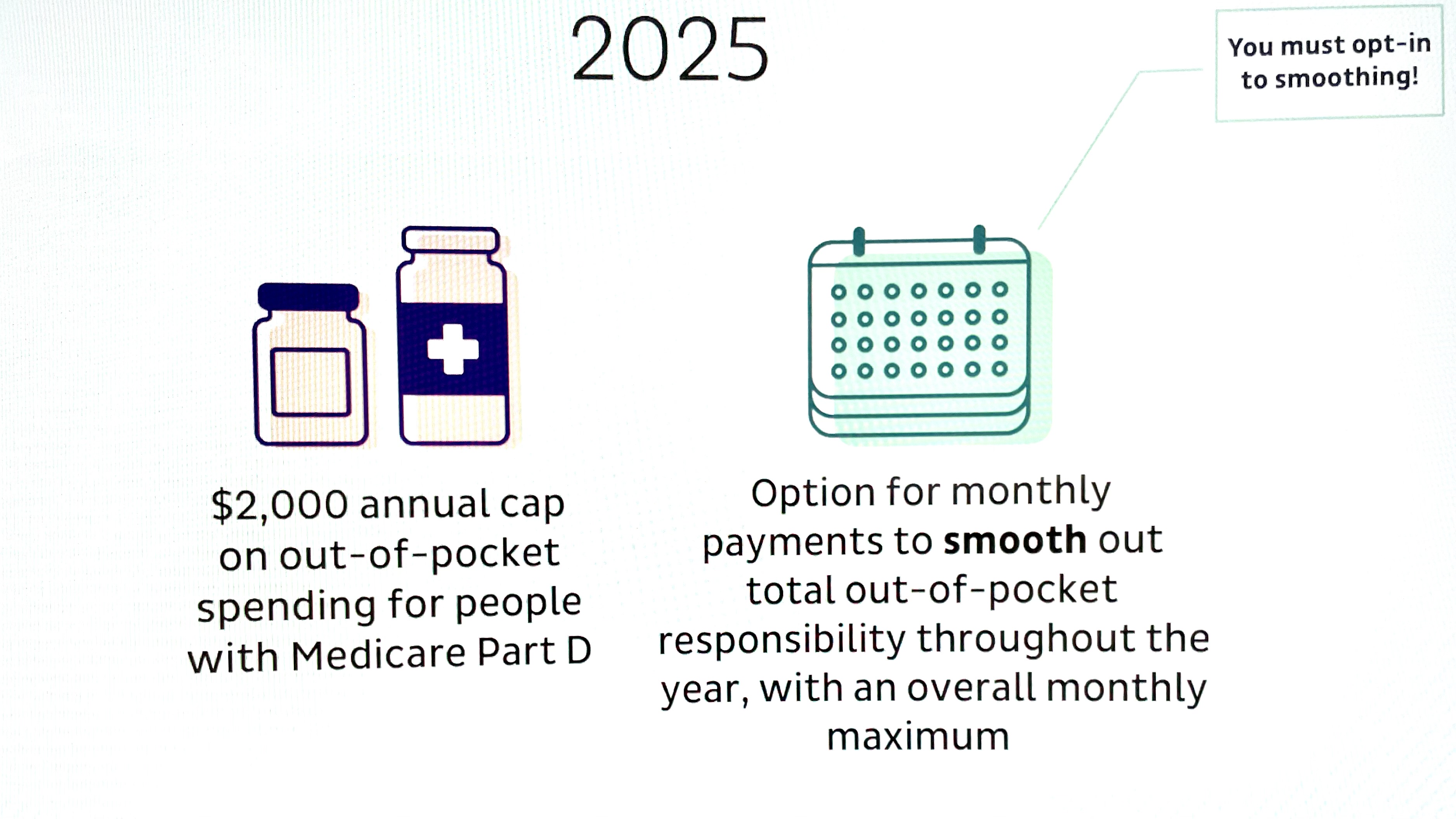
Relative to Medicare Part D Prescription Drug plans, as is the case in 2024, there is no beneficiary cost sharing above the annual OOP threshold. That will be $2,000 in 2025. That’s down from $8,000 in 2024! The coverage gap phase (also known as the “donut hole”) will be eliminated, which will result in standard Part D coverage consisting of a three-phase benefit: a deductible phase, an initial coverage phase, and a catastrophic phase. The annual Part D Drug Plan deductible caps at $590, up from $545 this year.

Here is how the changes take effect for the coming calendar years.

  • 2025The Inflation Reduction Act will lower out-of-pocket costs for Medicare Part D enrollees to a maximum of $2,000 per year. The Coverage Gap Discount Program will end and be replaced by the Manufacturer Discount Program. The standard Part D benefit design will also change to include three phases: deductible, initial coverage, and catastrophic coverage. The law will also require Part D plans to offer enrollees the option to pay for prescription drugs in capped monthly payments instead of all at once. 
  • 2027: Medicare will negotiate costs for 15 Part D drugs. 
  • 2028: Medicare will negotiate costs for 15 Part B and Part D drugs. 
  • 2029: Medicare will negotiate costs for 20 Part B and Part D drugs. 
  • Every year after 2028: Medicare will negotiate costs for 20 Part B and Part D drugs. 

IN REVIEW:

In 2025, Medicare Part D, the federal program that helps Medicare beneficiaries pay for prescription drugs, will undergo significant changes aimed at reducing out-of-pocket costs for seniors and improving access to necessary medications. These changes are part of the ongoing implementation of the Inflation Reduction Act (IRA) of 2022, which introduced sweeping reforms to the healthcare system, particularly in prescription drug pricing.

Key Changes in 2025

1. Introduction of a $2,000 Out-of-Pocket Cap

One of the most anticipated changes is the introduction of a $2,000 annual cap on out-of-pocket costs for prescription drugs under Medicare Part D. This cap will significantly ease the financial burden for many seniors who, in previous years, faced unlimited out-of-pocket expenses once they passed through the “donut hole” coverage gap.

This new cap means that once a beneficiary’s spending on covered drugs reaches $2,000 in a year, Medicare will cover the remaining costs, ensuring that seniors are not overwhelmed by high medication expenses.

2. Expanded Access to Low-Income Subsidies

Starting in 2025, eligibility for the Low-Income Subsidy (LIS), also known as “Extra Help,” will be expanded. Previously, this subsidy was available only to individuals with incomes up to 150% of the federal poverty level. In 2025, the threshold will be increased to 200% of the federal poverty level, allowing more seniors to qualify for additional financial assistance. This expansion is expected to help millions of low-income seniors reduce their prescription drug costs even further.

3. Price Negotiations for High-Cost Drugs

Another major change is the implementation of Medicare’s ability to negotiate drug prices directly with pharmaceutical companies. Starting in 2025, Medicare will begin negotiating the prices of 20 high-cost drugs that are covered under Part D. This is a historic shift in policy, as Medicare has previously been prohibited from negotiating drug prices.

The drugs selected for negotiation will be among the most expensive and widely used by Medicare beneficiaries. The goal is to bring down the cost of these medications, resulting in lower premiums and out-of-pocket costs for beneficiaries.

4. Elimination of the Coverage Gap (Donut Hole)

The infamous “donut hole” in Medicare Part D coverage will be fully eliminated in 2025. This gap in coverage previously required beneficiaries to pay a higher percentage of their drug costs after their spending reached a certain limit until they qualified for catastrophic coverage. With the donut hole’s elimination, seniors will no longer experience a sudden increase in out-of-pocket costs, making drug costs more predictable and manageable throughout the year.

5. Enhanced Catastrophic Coverage

In conjunction with the out-of-pocket cap, changes to catastrophic coverage will also take effect. Once a beneficiary’s drug spending surpasses the $2,000 threshold, they will enter catastrophic coverage, where Medicare will cover 100% of the drug costs for the remainder of the year. Previously, beneficiaries were still required to pay 5% of their drug costs even in the catastrophic phase.

Impact on Beneficiaries

These changes are expected to have a profound impact on Medicare beneficiaries, especially those with chronic conditions who rely on expensive medications. The $2,000 out-of-pocket cap, in particular, is seen as a game-changer, as it will provide financial relief to millions of seniors who previously faced unlimited costs for their medications.

The expansion of the Low-Income Subsidy will also bring much-needed assistance to a broader range of seniors, ensuring that those with limited financial resources can afford their prescriptions.

To further assist Medicare recipients with large prescription drug costs until such time as they have reached their $2,000 annual maximum out-of-pocket, Medicare is implementing the MEDICARE PRESCRIPTION PAYMENT PLAN (M3P), also known as the “Smoothing” because it allows Medicare Part D beneficiaries to pay their of Out-of-Pocket Prescription Drug Costs Over the course of the Year.”

Elements of M3P:

  • Monthly Installments: Starting in 2025, beneficiaries will have the option to spread out their out-of-pocket costs over the course of the year, rather than paying large sums at once when they fill prescriptions. This “smoothing” option is designed to make it easier for beneficiaries to manage their drug costs.
  • All Part D members will be eligible to opt into the program for 1/1/2025, regardless of low-income status.
  • Once opted into the program, members pay $0 at the pharmacy.
  • The drug plan will pay the pharmacy the cost of the drug in full along inclusive of the member’s cost share. The Medicare recipient will then pay their drug cost in monthly installments, billed by the plan, over the course of the year, using the Center for Medicare Services (CMS) prescribed payment methodology.  

As alluded to previously, these improvements in benefits will not be without consequences. While the 2025 changes to Medicare Part D are widely welcomed, they are not without controversy. In addition to potential increases in Part D and Medicare Advantage Part D premiums, some critics argue that the drug price negotiation process could lead to reduced access to certain medications if pharmaceutical companies decide to withdraw drugs from the Medicare program rather than negotiate lower prices. There are also concerns about the long-term sustainability of these reforms and their potential impact on the pharmaceutical industry’s ability to innovate.

Conclusion:

As 2025 approaches, Medicare beneficiaries should begin to familiarize themselves with these upcoming changes and how they may affect their prescription drug coverage. The enhancements to Medicare Part D reflect a broader effort to make healthcare more affordable and accessible for seniors, addressing long-standing issues in the system. While the full impact of these reforms will unfold over time, the changes in 2025 mark a significant step forward in improving the financial security and well-being of millions of Medicare beneficiaries.

For changes in covered and non-covered drugs, see Feature Article 1 below.

Please contact me directly with any questions or concerns as the details of changes to your current plan become available. I can help you review all the 2025 options available to you in the marketplace and would welcome you as a client. Remember, we can enroll in a new Part D Drug Plan for 2025 beginning 10/15/2024.

Donald Kenton Henry, Jr

Office: 281-367-6565
Text my cell 24/7 @ 713-907-7984
Email: Allplanhealthinsurance.com@gmail.com
Https://HealthandMedicareInsurance.com
Https://Allplanhealthinsurance.com

FEATURE ARTICLE 1:

Study Finds Drug Coverage Changes in Medicare Part D Plans

August 22, 2024

By Denise Myshko

Avalere’s Kylie Stengel talks about the regional shifts in formularies and utilization management in Medicare Part D prescription drug plans.

The number of both the standalone prescription drug plans (PDP) and the low-income subsidy (LIS) benchmark plans in Medicare Part D decreased between 2023 and 2024, according to a new review from Avalere.

Of the 801 prescription drug plans offered in 2023 across the United States, 95 were no longer offered in 2024, which is a decrease of 12%. Additionally, almost half of Medicare beneficiaries enrolled in the low-income benchmark plans were in plans that lost benchmark status, meaning enrollees had to choose a new plan or pay a premium in 2024.

“We did see a reduction in the number of PDP offerings in general, but this is really a significant decrease in specifically the LIS benchmark plan offerings,” Kylie Stengel, associate principal at Avalere said in an interview. “We do believe that is due to the changing market conditions under the Inflation Reduction Act, although not all of the IRA changes are in effect as of yet. These changes together have changed how plans thought about their offerings for 2024.”

The Inflation Reduction Act’s $35 cap on insulin out-of-pocket costs went into effect in January 2023. Next year will see two important elements of the Inflation Reduction Act being implemented: a $2,000 cap on out-of-pocket costs under Part D and the Prescription Payment Plan, sometimes called the “smoothing” program, where beneficiaries with Medicare Part D drug coverage will have the option to pay out-of-pocket costs in monthly payments spread out over the year.

Medicare Part D provides prescription drug coverage to supplement traditional Medicare or Medicare Advantage plans. In 2023, more than 50 million of the 65 million Medicare beneficiaries were enrolled in Part D plans.

Seniors with low incomes are eligible for prescription drug coverage from plans that meet a certain benchmark for no additional premium costs. The benchmark is the maximum premium that the Medicare program will pay for drug plan coverage.

“The benchmark is an enrollment weighted average in each region,” Stengel said. “CMS takes the average of all bids from both PDP and Medicare Advantage plans and sets a premium amount by region.”

In its analysis, Avalere assessed data from the Part D Public Use Files for 2023 and 2024 from the Centers for Medicare and Medicaid Services. This data contains information about formulary, cost sharing, and utilization management for Medicare prescription drug plans.

Avalere researchers looked at coverage changes and focused on 24 of the most used, single-source branded drugs in five therapeutic categories: anticoagulants; asthma/chronic obstructive pulmonary disease (COPD) autoimmune; multiple sclerosis and pulmonary hypertension. Avalere, however, is not releasing the names of the drugs they analyzed.

Researchers conducted two sets of comparisons. In the prescription drug plans, they looked at. Changes in formularies from 2023 and 2024 and the differences for plans that exited the market. They also assessed the low-income benchmark plans for whether they maintained benchmark status and the differences in formularies in plans that lost and plans that maintained benchmark status.

“When you look under the hood, when you look at specific therapeutic areas and regions, there is a lot of variability,” Stengel said. “When you’re looking across all drugs at a national level, you might not see a lot of change.”

One of the biggest areas to see change was the coverage of drugs to treat patients with pulmonary hypertension. In 2023, 39% of plans covered the drugs for pulmonary hypertension. In 2024, just 30% of plans did.

Avalere also found regional differences in coverage for some therapeutic areas. For example, coverage of drugs to treat patients with multiple sclerosis was lower among plans that remained in the market in 2024 in 11 regions but higher in 13 regions.

Avalere found that cost-sharing changes were limited for autoimmune, multiple sclerosis, and pulmonary hypertension drugs. However, use of coinsurance for anticoagulants and drugs that treat patients with asthma/COPD increased substantially for all prescription drug plan comparisons.

For the low income subsidy benchmark plans, there were regional differences on the utilization management used for the anticoagulant drugs. In five regions, there was a 20-percentage-point or more difference in utilization management among plans that lost benchmark status compared with plans that maintained benchmark status.

“It’s hard to know what factors are driving this; we didn’t do an assessment in terms of why there might have been a decrease in coverage for some of these therapeutic areas. But pulmonary hypertension is an area with a lot of higher cost drugs so we thought might expect there to more changes,” Stengel said. “Plans might be reacting to the elimination of patient cost-sharing to reduce their financial risk.”

But she said it may be too early to predict plan offerings for 2025. “I think we can expect potentially there to be less enhanced plans in the market just because the overall the basic benefit is a richer compared with previous years.”

Leave a comment

Medicare Recipients Get Short End of the “Affordable Care Act” Stick

Op-Ed

Admin. – Kenton Henry


It seems to me, Medicare recipients are forfeiting the most benefit and assuming the greatest liability as a direct result of the Patient Protection and Affordable Care Act (ACA) of any group of Americans. This opinion is based, in part, on two traps recipients can fall into which can significantly compromise their financial and physical well-being. To appreciate them, you must first understand:


What is this new Center for Medicare Services Re-admission program and what is the purpose of it?


The Affordable Care Act of 2010 requires HHS to establish a readmission reduction program. This program, effective October 1, 2012, was designed to provide incentives for hospitals to implement strategies to reduce the number of costly and unnecessary hospital readmissions. CMS defines a readmission in this context as “an admission to a subsection(d) hospital within 30 days of a discharge from the same or another subsection(d) hospital.” Subsection(d) hospitals, per the Social Security Act, include short term inpatient acute care hospitals excluding critical access, psychiatric, rehabilitation, long term care, children’s, and cancer hospitals. http://www.acep.org/Legislation-and-Advocacy/Practice-Management-Issues/Physician-Payment-Reform/Medicare-s-Hospital-Readmission-Reduction-Program-FAQ/


What this gets down to is–if a hospital readmits a patient within 30 days of a prior hospitalization–they pay a penalty. What is the Center’s motivation? We already know that last year the administration authorized the transfer of approximately $716 billion from Medicare to fund Obamacare. Medicare is projected to be on the path to insolvency around 2023. A Medicare recipient (or his private insurance plan) is charged a $1,184 deductible per hospital stay for each medical condition or for the same medical condition separated by 60 days or more. Therefore, if a patient is readmitted within 30 days for the same medical condition – no deductible is due. Medicare pays the full cost for the stay. On track to be broke (and having shifted dollars to those under the age of 65 in need of health care) Medicare has created a disincentive to readmit patients by fining the hospital when this takes place. The objective is to encourage alternative methods and venues for treatment.

 
If you are, or will someday be, a Medicare recipient – how do you feel about this? If you think you really would like to be more closely monitored because of your fragile heart – do you really want your provider saying, “There is a pill for that!” and sending you home with your spouse? Certainly readmissions have been unnecessary in the past. Certainly, some were ill advised. But don’t you think the decision whether to readmit you should be left to your doctor free of considerations of poor job performance. Free of concern about the hospital blaming him or her for any penalties they must pay?
The second trap lies in failure to know whether your hospital admission is classified as for “medical observation” or “in-patient”?
The difference in terminology is not a mere technicality. The distinction can make all the difference in terms of your financial liability and leave you with a huge hospital bill. The trap is set when the hospital does not inform you or your guardian of your status upon admission. If you are not an in-patient–guess what? You are an out-patient. Without supplemental coverage, you will be responsible for the 20% (plus excess charges) of your out-patient medical expenses Medicare does not pay. People kept in the hospital beyond the usual 24-48 hours for observation can find themselves responsible for tens of thousands of dollars depending on the length of their stay.
Now . . . follow the bouncing ball on this. If a hospital does not code a stay an admission – it does not get penalized if, within 30 days, it then does admit the patient. Hence, a hospital has in essence double dipped. It’s billed you and Medicare both as an out-patient and an in-patient while avoiding penalties. Is it simply smart business or do the Medicare regulations and their accompanying financial incentives / disincentives affect the decision making process of your doctor? A more detailed analysis of these issues is outlined in the feature articles below. Mine is just an opinion piece but . . . methinks something may be rotten in Denmark.
Your counter points are welcomed.
****************************************************************
FEATURE ARTICLES:
NEW BEDFORD (MA) STANDARD TIMES
By BEVERLY FORD
NEW ENGLAND CENTER FOR INVESTIGATIVE REPORTING
August 25, 2013 12:00 AM
Massachusetts hospitals will lose millions of dollars in funding this year — and perhaps tens of millions more in the future — because of penalties imposed by the federal Medicare program on hospitals that excessively readmit some of the state’s sickest patients, the New England Center for Investigative Reporting has found.
“In Massachusetts, we’re facing approximately $5 billion in cuts to Medicare over 10 years,” said Tim Gens, executive vice president with the Massachusetts Hospital Association. Add to that an anticipated $1.5 billion in sequestration cutbacks due to be imposed in January along with other potential funding cuts, and “it’s a very scary time for hospitals,” Gens notes.
A provision of the Affordable Care Act of 2012, the Hospital Readmission Reduction Program was designed to force hospitals to change the way they treat elderly patients by keeping them out of the hospital and in their own homes. To realize that goal, Medicare imposed penalties that increase annually from less than one percent in fiscal 2012 to a top rate of three percent by 2014, based on a hospital’s total Medicare payments
“In the long run, it will reduce per patient cost because if a patient isn’t going back into the hospital to have the same treatment done, we’re not going to be paying for those same treatments twice,” Ray Hurd, regional administrator of the Centers for Medicare and Medicaid Services, said of the penalties.
It’s not that Medicare is against readmissions, Hurd said. Patients who need hospital care will still be able to get it. The policy only aims to cut unnecessary readmissions.
With Medicare’s penalty program in its early stages, however, it’s still too soon to tell whether reducing readmissions will actually result in better patient care, said Katherine Baicker, a professor of Health Economics at Harvard.
“The goal is to reduce patients from coming back to hospitals because it’s not good for patients and it’s not good for Medicare,” said Baicker.
Nationally, one in five Medicare patients is readmitted to a hospital annually at an estimated cost of $17.5 billion. Under its new program, Medicare expects to save about $280 million in the first year alone.
In Massachusetts, of the 61 hospitals that accept Medicare payments, 54, or 88 percent, were penalized during fiscal 2012 under the readmission reduction program, according to Medicare statistics. That program targets seniors who are most likely to be re-hospitalized within 30 days for pneumonia, heart failure and heart attacks, the three ailments Washington claims are responsible for 30 percent of all elderly readmissions.
Of those 54 penalized hospitals, 12 received the severest penalties which require them to pay back between 0.90 and 1 percent of all Medicare funds received during fiscal 2012. Many of those penalties, health officials said, were imposed against “safety net hospitals” that treat poor and minority communities and teaching hospitals, where mortality rates are often low.
“We all agree readmissions are an important thing we need to work on, but the concern about the penalty is that it really penalizes hospitals for things that are out of their control,” said Karen Joynt a cardiologist and instructor in health policy at Harvard School of Public Health who has studied readmission rates.
The data, she says, shows outside factors such as access to outpatient care, patients with mental health or substance abuse issues, seniors with chronic health conditions and a transient patient population dramatically affect the number of patients hospitals readmit.
Yet, while many larger hospitals are feeling the pinch, others aren’t getting penalized at all, Joynt said.
“The bad part is that the penalties seem so unfair,” she said.
The Massachusetts Hospital Association agrees.
“The penalties are flawed,” said Gens, whose organization has been working with Bay State hospitals to reduce readmission rates since 2009. “The time has come for policymakers to realize this (policy) was not a good decision.”
A congressional advisory committee concurred.
In June the Medicare Payment Advisory Committee suggested that Congress change the penalty formula by setting annual target readmission rates and exempt from penalties those hospitals that reach those targets.
Dr. Robert Klugman, chief quality officer for UMass Memorial Health Care system, the largest healthcare system in Central and Western Massachusetts, said the real worry, however, is that the pressure put on hospitals will cause some medical facilities to turn away patients that really do need to be readmitted.
“We clearly have to change the trajectory of healthcare costs,” Klugman said. “The problem is when you look at Medicare, they place rules to penalize the bad people but sometimes it hurts the innocent people too.”
Whether the penalties are unfair or not, hospitals still find them to be burdensome, taking away money that would generally be used for equipment, programs and treatments that could benefit Medicare patients and others as well.
At Beth Israel Deaconess Medical Center in Boston, Dr. Kenneth Sands, senior vice president of Health Care Quality, said the hospital expects to lose $2 million in Medicare funding in the fiscal year that began Oct. 1, 2012.
“It’s a relatively big portion of our budget,” Sands said of the Harvard-affiliated teaching hospital, one of several teaching facilities affected by the Medicare penalties. Because Beth Israel Deaconess operates on “very low margins” of about 2 percent annually, the impact is noticeable, Sands said.
It also means there will be less money for capital outlay, infrastructure improvements and new programs — “all the things that keep us one of the better medical centers nationally,” he said, adding that the cutbacks should have no affect on patient care or result in additional patient charges.
Klugman said he too worries that the $1.5 million in penalties imposed on the UMass Memorial Health Care system this fiscal year may impact the six hospitals served under the UMass system.
“If we have less income, we can’t invest in necessary equipment. We’ll be forced to reduce programs and services,” Klugmen said.
Toby Edelman, a senior policy attorney for the non-profit Center for Medical Advocacy in Washington, DC, says Medicare’s mandate may also be too daunting for some hospitals, forcing them to look to alternative measures to meet the government’s new standards.
To skirt Medicare’s readmission rules, she said, more hospitals may begin classifying returning patients as “outpatients” even though the patients may spend the same amount of time in the hospital and get the same tests, medications and other care given to admitted patients.
The problem with outpatient status, however, is that patients who need additional care outside of a hospital — in a nursing home for example — may end up paying for that care out of their own pocket since Medicare reimburses for outside costs only when admitted patients transition into a nursing home or rehabilitation center setting, Edelman explained. Patients classified as “outpatients” just don’t qualify.
Take, for example, the 86-year-old woman who was listed as an outpatient during her hospital stay and ended up with a nursing home bill of more than $17,000. Another family cashed in an elderly relative’s life insurance policy to pay for nursing home care after their loved one was hospitalized as an outpatient instead of being listed as admitted.
“It’s very frightening,” said Edelman. “People assume when they’re in a hospital bed they’re an admitted patient. (But) a lot of people are listed as observation status for much of their stay.”
Yet, hospitals say they are making progress.
At Beth Israel Deaconess and at other medical facilities, new programs are being implemented that help Medicare patients deal with their own healthcare after they are discharged. By hiring nurses to check on patients, forging partnerships with doctors, nursing homes and other facilities and installing software that can predict which patients will need more help after leaving the hospital, Beth Israel Deaconess has cut readmission rates by between 15 and 20 percent, Sands said.
Helping to fund that program is a $5 million federal grant that will allow the hospital to add seven transition councilors to help patients make the move from hospital to home. The grant will also place four pharmacists in the community and employ nurse practitioners to work with family members and primary care physicians to ensure that post-discharge plans are followed.
At UMass Memorial and its sister hospitals, staff members work closely with high-risk patients to ensure that once discharged, they have ample outside resources to help in their recovery.
“We do everything we can to make sure they have a soft landing,” said Klugman.
That includes contacting patients within 24-hours after they are discharged to see if they need further assistance from a nurse. The hospital also is implementing software to identify patients who may require frequent hospitalizations. The measures have already helped the hospital system cut readmission rates by about 20 percent. Whether that’s enough to reduce next year’s Medicare penalty, remains to be seen, says Klugman..
Yet, Baicker remains optimistic.
“The hope is that this improves the quality of care,” she said.
Now that’s something just about everyone — even Medicare — can agree on.
The New England Center for Investigative Reporting (www.necir-bu.org) is a nonprofit newsroom based at Boston University. NECIR intern Anais Vaillant contributed to this report.
***************************************************************
Medicare Billing Practices Detailed.
On its front page, the Boston Globe (8/25, Kowalczyk) details how Medicare patients can face higher hospitalization costs depending on whether their stay is classified as “medical observation” or “inpatient.” Medicare patients who are under “observation” receive “a huge bill” even though they “usually share rooms with regular inpatients and receive care from the same doctors and nurses, making their status invisible to them.” Although “hospitals say it’s not their fault,” facilities “are increasingly keeping patients in observation status longer” than the usual 24 to 48 hours. Some claim that the growing trend is “a response to aggressive reviews of hospital billing practices in recent years.”
The Cleveland Plain Dealer (8/24, Harris) reported on the case of an 83-year-old woman who is being sued by a nursing home for a $6,000 bill that went unpaid because she was admitted after nine days of “observation” at a hospital instead of the three days of inpatient care required by Medicare. The Plain Dealer says that the Center for Medicare Advocacy is suing HHS on behalf of Theresa McGarry and other Medicare patients who face bills that are $10,000 on average for being transferred to another facility without the in-patient classification. The Plain Dealer says it “may take an act of Congress” to help McGarry.
In a similar article, the Pittsburgh Tribune-Review (8/25, Nixon) reported on the case of an 85-year-old woman who “was surprised by a $15,000 nursing home bill after spending three days in a hospital for a broken ankle in 2009,” only to find out that she was “under observation” at the hospital, which “doesn’t count toward the three-day minimum needed for Medicare coverage.” The Tribune-Review says that Betty Rickett eventually filed for bankruptcy and is among the “estimated 600,000 Medicare beneficiaries” similarly affected by being admitted for observation. It says that “like Rickett, most people who are hospitalized never know they are under observation and not admitted.”

***************************************
BOSTON GLOBE

Status of Medicare patients can result in huge bills
Elderly patients hospitalized but not ‘admitted’ can face higher costs
By Liz Kowalczyk
| Globe Staff
August 25, 2013
Harold Engler recently spent 10 days in a Boston teaching hospital, trying to snap back from complications after urgent hernia surgery. Nurses provided around-the-clock treatment, changing the 91-year-old’s catheter, for example, and pumping him with intravenous drugs for suspected pneumonia.
It all seemed like textbook hospital care to his wife, Sylvia. So she was shocked to learn that Beth Israel Deaconess Medical Center had never “admitted” her husband at all.
“Mrs. Engler, we have bad news for you. This was marked ‘medical observation,’ ” said a nurse at the nursing home where her husband was sent for rehabilitation. The hospital had decided Harold Engler was not sick enough to qualify as an official “inpatient.”
The difference in terminology was not a mere technicality: the observation classification left the Englers with a huge bill. It triggered a mystifying Medicare rule that required the Framingham couple to pay the entire $7,859 cost of his rehabilitation care and the medications he needed while at the nursing facility. If Harold Engler, a retired sales executive, had been admitted to the hospital, they would have likely paid nothing.
It is a striking example of just how impenetrable the US health care system can be for those who use it. Thousands of Medicare enrollees in Massachusetts and across the country are finding themselves caught in the same perplexing bind: Despite long hospital stays, they have been deemed observation patients or outpatients whose follow-up care is not covered. They also can face higher costs for the hospital stay itself when they are not officially admitted.

These observation patients usually share rooms with regular inpatients and receive care from the same doctors and nurses, making their status invisible to them. “I just assumed he was an inpatient. He was on a medical floor,’’ Sylvia Engler said.
Hospitals say it’s not their fault. Executives at Beth Israel Deaconess and other institutions say they are just trying to follow Medicare billing rules that even they don’t always fully understand.
Medicare originally intended observation care as a way to give doctors time to evaluate whether a patient should be admitted to the hospital or is stable enough to go home, usually within 24 to 48 hours. But hospitals are increasingly keeping patients in observation status longer: 8 percent of Medicare recipients had observation stays longer than 48 hours in 2011, up from 3 percent in 2006.
That increase may partly be a response to aggressive reviews of hospital billing practices in recent years. Medicare contractors have demanded refunds from hospitals that admit patients the government believes should have been treated as observation patients or outpatients. Medicare pays hospitals less for those patients.
Medicare officials said they could not comment, in part because the American Hospital Association last year filed a lawsuit against the federal government over the issue.
Beth Israel Deaconess reached a $5.3 million settlement with the government last month over allegations that it improperly admitted patients between 2004 and 2008. And while the hospital denied any wrongdoing, investigators implied the hospital was motivated by profit.
Sylvia Engler believes the hospital has now gone too far in the other direction. She cashed in a money market account to pay the nursing home bill, and took her case to Diane Paulson, a senior attorney at the Medicare Advocacy Project of Greater Boston Legal Services. Paulson plans to appeal to Medicare.
Toby Edelman, senior policy attorney at the Center for Medicare Advocacy in Washington, D.C., said she believes hospitals also could be trying to avoid readmission penalties, which are assessed if too many patients are readmitted within 30 days. Harold Engler, for example, went home after five days, grew sicker, and then returned for another five-day observation stay. If he had been an inpatient, he would have counted as a readmission within 30 days.
Dr. James Hart, who heads a Beth Israel Deaconess committee that makes sure the hospital follows Medicare rules, said he could not comment on Engler’s case. But he said the hospital uses a sophisticated computer program that tries to match patients with the correct Medicare designation based on their illness and the intensity of hospital services required. “We are very focused on getting the level of care accurate,’’ he said.
JONATHAN WIGGS/GLOBE STAFF
Ann Gillis paid a $7,100 rehabilitation bill after a stay at Milton Hospital, where she wasn’t considered an inpatient.
Case managers generally inform patients of their status, especially if they require skilled nursing care, he said. But that doesn’t mean patients digest the information, at a time when they have so much to focus on. “Part of the challenge from a patient perspective is there really is an information overload,’’ Hart said.
Ann Gillis also was surprised to learn she wasn’t a hospital inpatient. At age 83, she fell in her Milton home in February. An ambulance sped her to Milton Hospital, where doctors discovered she had broken her pelvis in two places. “The doctor said, ‘We are going to send you upstairs,’ ’’ she recalled.
Gillis was in terrible pain but doctors decided she didn’t need surgery. Instead, they provided pain medication and advised her to lay absolutely still. On the fourth day, a hospital social worker said she would require rehabilitation at a nursing home. To her surprise, the social worker said she’d have to pay herself.
“I was not admitted and I didn’t know that,’’ Gillis said. “I was in a regular bed and a regular room.’’ Gillis used part of her IRA to pay $7,100 for two weeks of rehabilitation. Medicare publishes a pamphlet titled “Are You a Hospital Inpatient or Outpatient? If You Have Medicare — Ask!” but she never saw it.
Since becoming aware of Gillis’s case, Milton Hospital executives said they have scheduled talks on navigating the health care system. Gillis’s first appeal to Medicare was rejected but she plans to file another.
In a letter to Medicare, Paulson described another case she is fighting. A 90-year-old Lynn woman with numerous medical problems fell and broke her shoulder and was rushed by ambulance to North Shore Medical Center. Two doctors and a caseworker recommended that she be admitted as an inpatient, but the caseworker’s supervisor overruled them. The patient had to pay $40,000 for rehabilitation in a nursing home.
“Our clinical staff and case managers do what is in the best interest of the patient, working within existing Medicare guidelines,’’ said Rich Copp, spokesman for Partners HealthCare, the hospital’s parent company. “However, it is no secret that current Medicare policy is not perfect.’’
If hospitals determined that these patients were not sick enough for inpatient care, who would be?
Hart said that Medicare lists operations that are always inpatient, including heart bypass and valve surgery and many neurosurgical procedures.
Beyond that, hospital doctors and managers decide case by case. A heart failure patient with fluid in the lungs and trouble breathing might feel better with a single dose of a diuretic. That patient likely would be listed as outpatient or observation. But if the patient required a longer round of medications to become stable, the patient probably would be admitted, he said.
“Medicare isn’t making this easy for patients,’’ he said.
Medicare officials have said they are concerned about patients being observed for days in the hospital without being admitted, and issued regulations this summer they believe will help provide clarity to hospitals. But advocates for the elderly are not so sure.
“They’re contradictory and unclear,’’ Edelman said.
The rules, which take effect Oct. 1, allow hospitals to change a patient’s care level up to a year after discharge. One worry is that patients will be switched from inpatient to observation status months after they leave the hospital — and get socked retroactively with a rehabilitation bill.
Instead, patient advocates back federal legislation that would require Medicare to pay for nursing home care after three days in the hospital — no matter what those three days are called. Medicare now requires a three-day inpatient stay before it will pay for nursing home care.
At the very least, Paulson said, patients should receive immediate written notice of observation status and the chance to appeal while they are still in the hospital. For now, she and Edelman recommend that patients and families always ask — and push back if needed.
Edelman said one patient’s son and her lawyer met with a hospital chief executive and convinced him to change the patient from observation to inpatient.
“Do anything you can to get the hospital to change your status,’’ she said.
**************************************************************************************************************************************************************

← Back

Thank you for your response. ✨


http://thewoodlandstxhealthinsurance.com